


How to Choose a Portable Infrared Sauna for Your Home
Last Updated: November 5, 2026
Quick Summary
To choose a portable infrared sauna, first pick the format that matches how you want to sit: a seated tent, a lie-down pod, or a blanket. Then measure your assembled footprint and storage space, confirm the 120V electrical draw, and compare heater count, wattage, and build rating against how often you will use it.
- A portable infrared sauna is a freestanding, plug-in far infrared unit that folds or packs away and needs no plumbing or wiring.
- Seated tents measure 32 inches wide by 33 inches deep by 46 inches high; the lie-down Flex measures 65 by 26 by 19 inches.
- The models we carry run on a standard 120V household outlet and draw 1,400 watts total.
- The Silver Elite and Black Pro share the same dual far infrared conductor set; the Black Pro adds a thicker silver-lined tent.
- The Black Pro is rated for 15 to 20 sessions a day, which suits daily or shared use.
Table of Contents
- Start With the Format: Tent, Dome, or Blanket
- Portable Sauna Blanket vs. Tent: Which Fits Your Routine
- Infrared Sauna Heater Types: Carbon, Ceramic, and What the Numbers Mean
- Portable Sauna Dimensions and Setup: Measuring Before You Buy
- Infrared Sauna Electrical Requirements and Circuit Planning
- Budget, Materials, and Total Cost of Ownership
- Compare the Three Relax Models Side by Side
- Match a Sauna to Your Room and Your Routine
- Frequently Asked Questions
Start With the Format: Tent, Dome, or Blanket
Choosing a portable infrared sauna starts with one question: how do you want to sit while you use it? The answer narrows your options faster than any specification sheet. At Stack For Wellness, we break the category into three formats, and each one suits a different room and a different routine.
A portable infrared sauna is a freestanding, plug-in far infrared unit that folds or packs away when not in use. It requires no plumbing, no wiring, and no permanent construction.
- Sauna tent: You sit upright on a folding chair with your head outside the opening. Best for small footprints and short sessions.
- Sauna pod or dome: You lie down, with heat reflected from a mat beneath you. Best if sitting upright is uncomfortable.
- Sauna blanket: You lie inside a heated wrap. Smallest storage footprint, least head clearance.
Tents and pods hold heat around the body while leaving your head in room air. Blankets pack smaller but give you almost no interior volume, so the experience feels different from a cabin.
One practical note before you shop: a tent and a pod are not interchangeable in a tight room. A seated tent needs roughly the footprint of a dining chair plus clearance to climb in. A lie-down pod needs the length of a yoga mat. Measure that floor space first, then read heater specs.
Portable Sauna Blanket vs. Tent: Which Fits Your Routine
The blanket-versus-tent decision comes down to how long you plan to sit and where the unit will live. A tent wins on heat experience. A blanket wins on storage.
Portable sauna blanket vs. tent comparisons usually skip the part that matters: session length. Tents hold warm air around your torso and legs, so a 20 to 30 minute session feels steady. Blankets sit directly against the body and heat faster at the surface, but the wrap limits movement.
- Choose a tent if: you want a seated session, you have a spare corner, and you want your head in cool air.
- Choose a blanket if: you live in a small apartment, you want to store the unit in a drawer, and you prefer lying down.
- Choose a pod if: you want to lie flat with reflected heat and you have floor length to spare.
The tents include a controller with holder, so you can set the level and timer without leaving the chair.
Infrared Sauna Heater Types: Carbon, Ceramic, and What the Numbers Mean
Infrared sauna heater types fall into two families: carbon-based panels and ceramic emitters. Both produce far infrared, and both warm a space rather than heating the air the way a steam sauna does. The difference shows up in warm-up time, heat distribution, and how the emitter is built.
Carbon panels spread heat across a wide surface, so the warmth feels even and the panel stays cooler to the touch. Ceramic emitters concentrate output in a smaller element and typically warm faster.
The numbers on a spec sheet tell you more than the material name:
- Wattage: total draw, and how it splits across emitters. Two 800-watt radiators is a different build from one 1,400-watt element.
- Wavelength: far infrared sits in the 7 to 14 micron band. A listing that states the range is more useful than one that says "far infrared" alone.
- Warm-up time: how long the cabin takes to reach its working temperature.
- Maximum temperature: the ceiling the unit can reach, not the temperature you will use every session.
A common mistake is comparing wattage without comparing emitter count. A single high-wattage element and a dual-radiator set can draw the same total power while distributing heat very differently. For a deeper walkthrough of what these figures mean in practice, read our guide to infrared sauna heater quality.
Watch out: a listing that quotes a wavelength range but never states emitter count or wattage split is telling you very little. Ask for both before you buy.
Portable Sauna Dimensions and Setup: Measuring Before You Buy
Portable sauna dimensions and setup planning start with a tape measure, not a product page. Two measurements decide whether a unit works in your home: the assembled footprint and the storage size.
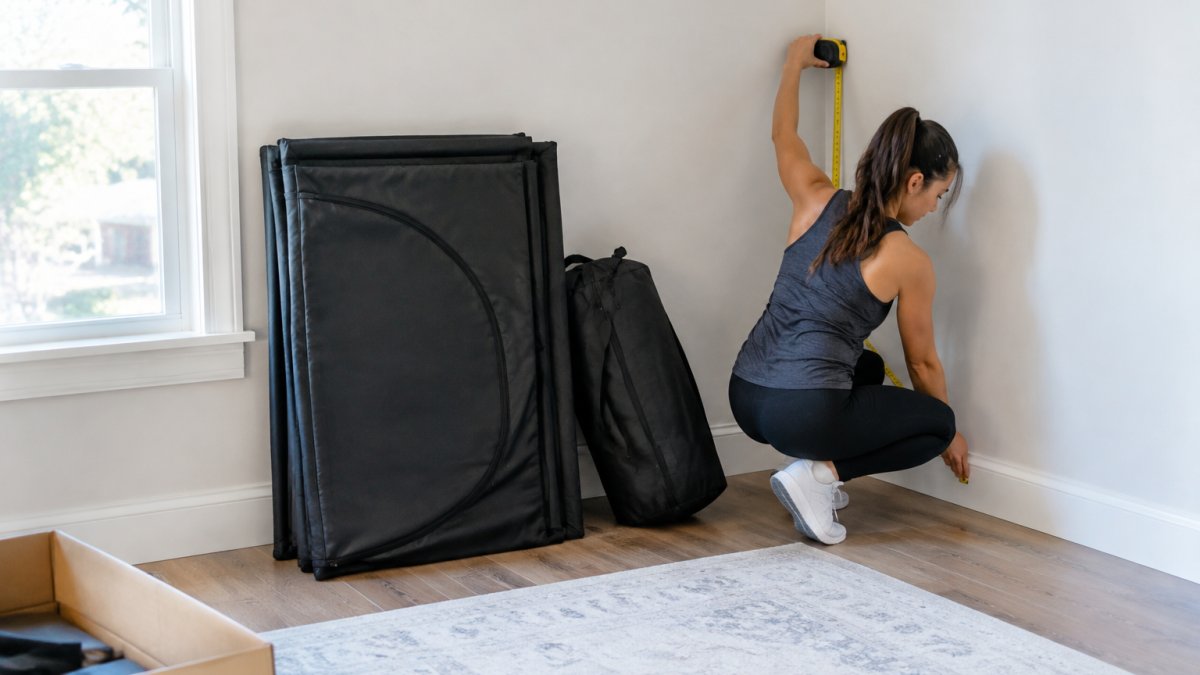
Take the assembled size first. A seated tent model in our catalog measures 32 inches wide by 33 inches deep by 46 inches high, which fits a corner roughly the size of a small armchair. A lie-down model measures 65 inches long by 26 inches wide by 19 inches high, with a separate mat at 78 by 36 inches. Those are different rooms entirely.
Then check three more things:
- Ceiling and door clearance on the route from the box to the room.
- Floor protection: a mat under the unit keeps heat off hardwood and carpet.
- Storage: folded size and carry bag dimensions, if the unit shares a room with anything else.
Setup is tool-free on the models we carry, and the units fold flat for storage.
Infrared Sauna Electrical Requirements and Circuit Planning
Infrared sauna electrical requirements are simpler than most shoppers fear, but they are not nothing. The models we carry run on a standard 120V household outlet and draw 1,400 watts total.
Three checks keep it safe:
- Dedicated circuit: run the sauna on a circuit that is not already carrying a space heater, hair dryer, or kitchen appliance.
- Outlet condition: a standard grounded outlet in good repair, not an extension cord daisy-chained across a room.
- Cord routing: keep the cord out of walkways and away from the tent fabric.
If you are unsure what else shares the circuit, a licensed electrician can tell you in minutes. We would rather you ask than guess.
Electromagnetic field ratings deserve the same scrutiny. Listings that mention low EMF should state how the figure was measured, at what distance, and by whom. If a seller cannot answer those three questions, the number is decoration. Our guide on how to verify low EMF sauna ratings walks through the questions to ask.
Budget, Materials, and Total Cost of Ownership
Total cost of ownership for a portable infrared sauna has three parts: purchase price, shipping, and the electricity a session uses. Most buyers plan for the first and forget the other two.
The Black Pro uses a thicker reinforced tent with a silver-lined interior, which warms faster and holds heat longer than the standard tent.
On running cost, do the arithmetic with your own numbers rather than a rule of thumb. A 1,400-watt unit drawing full power for one hour uses 1.4 kilowatt-hours. Multiply that by your local rate and by your weekly session count, and you have a real annual figure. Shorter sessions and lower settings reduce it further.
Match the build rating to how often you will actually use it. The Black Pro is rated for 15 to 20 sessions a day.
Compare the Three Relax Models Side by Side
All three Relax models share the same far infrared radiator technology, so the choice comes down to format, tent build, and price. Here is how they line up.
| Model | Format | Assembled Size | Power | Price | Best For |
|---|---|---|---|---|---|
| Silver Elite Sauna | Seated tent | 32" W x 33" D x 46" H | 1,400 W, two 800 W radiators | $1,700 | Value pick for personal or family use |
| Relax Black Pro | Seated tent | 32" W x 33" D x 46" H | 1,400 W | $2,300 | Frequent use, heavier-duty tent |
| Flex Lie Down Sauna | Lie-down pod | 65" L x 26" W x 19" H | 1,400 W | $1,700 | Lying flat instead of sitting upright |
The Silver Elite and the Black Pro use the identical patented dual far infrared conductor set, so heat output is the same. The Black Pro's upgrade is the tent: thicker material with a silver-lined interior that warms faster and holds heat longer.
The Flex swaps the chair for a reflective mat and a lie-flat design, with your head resting outside the opening on an inflatable headrest. Same heat source, different body position.
Best for: the Silver Elite suits a household that wants a seated session at the lowest price. The Black Pro suits daily, heavy use. The Flex suits anyone who finds sitting upright uncomfortable.
Skip if: you have no floor length for a 65-inch pod, in which case a seated tent is the practical choice.
You can see the full specifications on the Relax Black Pro Portable Far Infrared Sauna, the Flex Lie Down Sauna, and the Silver Elite Sauna product pages.


Match a Sauna to Your Room and Your Routine
Matching a sauna to your life is the step most buying guides leave out. A unit that fits your space but not your schedule ends up folded in a closet.
Start with the routine. If you want a short session after a workout, warm-up time matters more than maximum temperature.
Then match the room. A seated tent needs a corner and a nearby outlet. A pod needs floor length and a flat surface. Neither needs plumbing, ventilation ducting, or a contractor.
Finally, match the build to the frequency. Occasional use suits a standard tent. Daily use, or a household where several people rotate through, points to a unit rated for heavier session counts.
Stack For Wellness curates recovery equipment as a cohesive set, and our product listings state dimensions, power, and heater specifications so you can compare like for like.
This product is intended for general wellness and relaxation. It is not a medical device and is not intended to diagnose, treat, cure, or prevent any disease.
Frequently Asked Questions
What is the difference between an infrared sauna blanket and a sauna tent?
A tent is a framed enclosure you sit or lie inside, with a radiator heating the air around you. The Relax tent models keep your head outside the heat through a neck opening and include a controller with holder.
How much space does a portable infrared sauna need?
The Relax Silver Elite and Black Pro tents both measure 32 inches wide by 33 inches deep by 46 inches high, so plan floor space for those dimensions plus clearance to get in and out. The Flex Lie Down Sauna needs a longer strip of floor: its tent is 65 inches long, and its reflective mat measures 78 by 36 inches. Measure the mat, not just the tent, before you commit to a spot.
Can a portable infrared sauna run on a standard 120V outlet?
All three Relax models in the Stack For Wellness catalog run on 120V AC and draw 1,400 watts total. Check what else shares the circuit before you plug in.
What should you check before buying a portable infrared sauna?
Confirm four things: the heater type and wattage, the exact tent and mat dimensions, the voltage and amp draw, and the warranty length. Ask what wavelength range the heater produces, and check the packed weight if you plan to move it between rooms. Finally, read the rated sessions per day, since a model rated for 15 to 20 sessions suits heavier use than one built for a single person.
A portable infrared sauna only earns its place if it fits your room, your outlet, and your schedule. Stack For Wellness stocks the Relax line with full specifications published, including heater count, dimensions, and materials, so you can compare models on facts. Browse the Silver Elite, Black Pro, and Flex Lie Down Sauna, then get started with Stack For Wellness and build a recovery corner that fits the space you actually have.


