


Infrared Sauna Heater Quality Explained: 2026 Guide
Table of Contents
- What Makes an Infrared Sauna Heater High Quality
- Carbon vs Ceramic Infrared Sauna Heaters
- Infrared Sauna Heater Specifications You Need to Know
- Infrared Sauna Heater Placement and Heat Distribution
- Infrared Sauna Heater Lifespan and Long-Term Durability
- Infrared vs Traditional Electric Sauna Heaters
- How to Choose the Right Heater for Your Space
- Frequently Asked Questions
- Frequently Asked Questions
Last Updated: October 10, 2026
What Makes an Infrared Sauna Heater High Quality
Infrared sauna heater quality determines heat distribution, durability, and whether you're getting genuine far-infrared wavelengths. The difference comes down to three core areas: material construction, electrical safety standards, and heater technology.

Material and Construction Standards
Quality infrared saunas use solid wood, typically Canadian red cedar or hemlock, because these species resist moisture, won't warp in high heat, and provide natural insulation.
Tongue-and-groove construction, where boards interlock along their edges, creates a stronger cabin than butt joints. Poor joinery develops gaps that leak heat and compromise temperature uniformity.
Tempered glass doors rated for high heat are non-negotiable. Standard glass shatters under temperature stress; tempered glass is heat-treated to withstand thermal shock.
EMF Output and Electrical Safety
Quality far-infrared heaters keep EMF output well below safety thresholds.
The difference lies in shielding and electrical design. Heaters with proper grounding, shielded wiring, and isolated power circuits minimize stray fields. Ask manufacturers for third-party EMF test results.
Electrical safety listings matter too. Look for ETL (Intertek) or UL (Underwriters Laboratories) certification on the sauna cabin itself, not just the heater.
Carbon vs Ceramic Infrared Sauna Heaters
Carbon and ceramic heaters dominate the infrared sauna market, and the choice between them affects heat quality, durability, and long-term cost. Both emit far-infrared wavelengths (around 9,000 nanometers), but the way they produce heat differs significantly.

How Each Type Emits Heat
Carbon heaters consist of carbon filaments suspended in a panel that glow and radiate infrared energy.
Ceramic heaters use ceramic plates or tubes that take 15 to 20 minutes to reach peak temperature but maintain consistent output throughout their lifespan.
Carbon heaters suit rapid heat-up and flexible schedules. Ceramic heaters work better for daily use where longevity matters more than speed.
Performance and Durability Comparison
Heater lifespan depends on the model, operating conditions and maintenance; request a model-specific service-life statement from the manufacturer. Replacement panels add to long-term costs.
Compare replacement-panel availability, warranty coverage and the manufacturer's warm-up specification rather than assuming a universal lifespan for either heater type.
Neither type is inherently "better." Carbon suits occasional or seasonal use; ceramic suits committed daily protocols. The Consumer Product Safety Commission guidance on electrical appliances emphasizes that durability claims should be backed by manufacturer testing data, not marketing language.
| Feature | Carbon Heaters | Ceramic Heaters |
|---|---|---|
| Warm-up time | 5-10 minutes | 15-20 minutes |
| Heat consistency | Even, immediate | Even, sustained |
| Expected lifespan | 3,000-5,000 hours | 10,000+ hours |
| Replacement cost | Moderate | Higher upfront, lower ongoing |
| Durability | Good, with maintenance | Excellent if undamaged |
| Best for | Flexible schedules | Daily dedicated use |
Infrared Sauna Heater Specifications You Need to Know
Specifications tell the real story about heater performance. Marketing claims are vague; specs are measurable. Understanding wavelength, wattage, temperature range, and warm-up time helps you compare units objectively.
Wavelength, Wattage, and Heat Output
Far-infrared wavelengths typically range from 8,000 to 10,000 nanometers, the standard for sauna cabins designed for relaxation and general wellness.
Wattage indicates total electrical power draw. A 2,700-watt sauna generates more heat faster than a 1,500-watt unit, but wattage alone doesn't determine quality.
Heater count and placement matter more than total wattage. Look for heaters positioned to cover the back, sides, and leg areas.
Temperature Range and Warm-Up Time
Quality infrared saunas reach 140°F maximum temperature.
Warm-up time is the interval from cold start to usable temperature (typically 120°F). Compare measured warm-up times for the specific models under similar room conditions rather than assuming one heater material always warms faster.
Temperature uniformity depends on heater placement and cabin design. Quality units maintain within 5 to 10 degrees across the entire interior.
Infrared Sauna Heater Placement and Heat Distribution
Where heaters sit inside the cabin determines whether you get even warmth or uncomfortable hot spots. This is where many budget saunas fail: they skimp on heater count and placement to cut costs, leaving dead zones.
Heater Count and Coverage Patterns
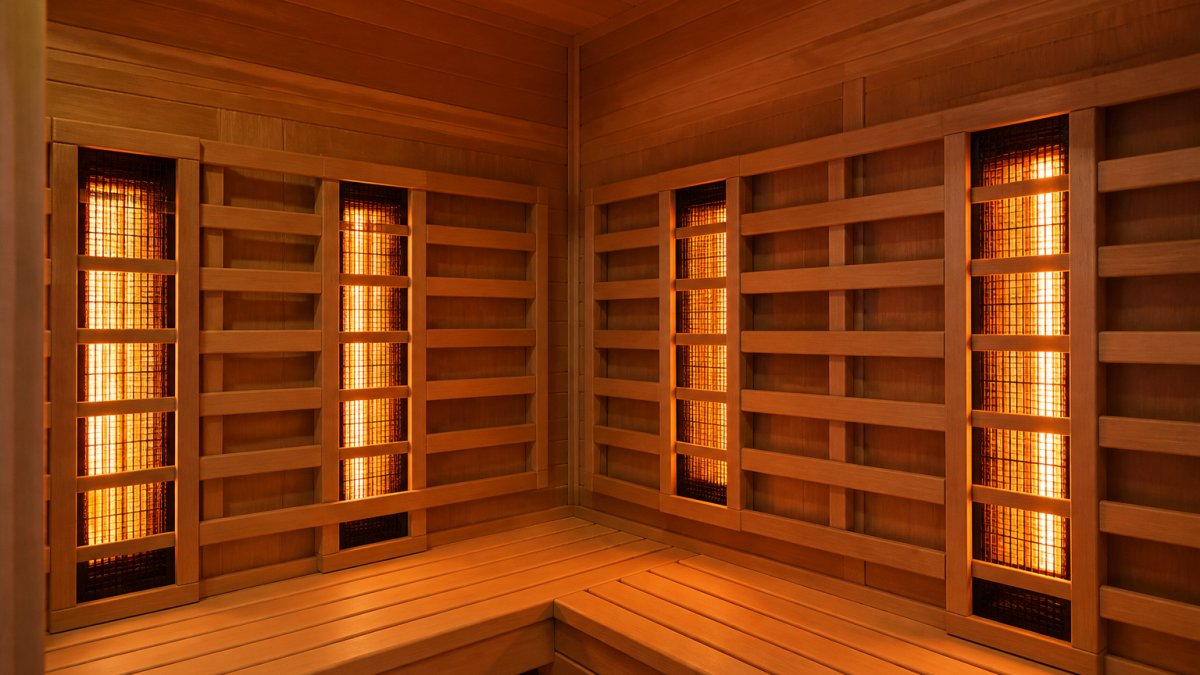
Heaters should wrap around the user: back wall, side panels, and foot-level heaters. A six-person sauna should have at least eight heaters; a two-person unit needs at least four to six.
Single-heater designs are a cost-cutting measure and should be avoided. The International Electrotechnical Commission standards for infrared heating emphasize that radiant heating systems must achieve uniform surface temperatures across the emission area to ensure safe, comfortable operation.
Quality designs place heaters at mid-wall height or higher, keeping the cabin floor clear and safe.
Temperature Uniformity Across the Cabin
A variance of more than 15 degrees between the hottest and coolest spots indicates poor design. You want consistent heat throughout the cabin.
Corner saunas often achieve better uniformity than square cabins. For example, the CASAINC 2-Person Corner Far Infrared Sauna is shaped to sit in a corner and features seven infrared panels. Two-person units with heaters on three walls typically outperform larger units with fewer heaters per person.

Infrared Sauna Heater Lifespan and Long-Term Durability
Durability determines whether a sauna is a sound investment or a recurring expense. The lifespan of the heaters themselves is just one factor; the cabinet, controls, and glass door all contribute to overall longevity.
Infrared Sauna Built for Deep Heat Therapy, 6-Person Cedar, 10 Carbon Heaters →
Maintenance and Replacement Cycles
Carbon heater panels degrade gradually.
Ceramic heaters maintain consistent output for thousands of hours and rarely need replacement unless physically damaged.
The cabinet requires minimal maintenance. Wipe interior surfaces with a soft cloth after each session. Check vents and glass doors weekly for debris. Use mild soap and water only.
How to Verify Quality Before Purchase
Ask the manufacturer for third-party test results on heater output, EMF emissions, and temperature uniformity. If a seller can't produce independent verification, look elsewhere.
Check the warranty terms. A quality infrared sauna comes with at least a 12-month manufacturer's warranty on the cabin and heaters. For example, the Durasage 2-Person Carbon Infrared Sauna and the Relax Silver Elite Sauna both come with a 12-month maker's warranty.
Infrared vs Traditional Electric Sauna Heaters
Traditional electric saunas use large heating elements that warm the cabin air to 180°F or higher.
Infrared saunas warm you directly through radiant energy, leaving the cabin air cooler.
Energy efficiency favors infrared. For example, the HeatWave Great Bear 6-Person Cedar Infrared Sauna is a 2,700-watt unit that runs on 240 V, 20 A.
For home use, infrared is a practical choice. It offers more control, lower operating costs, and easier installation than traditional saunas.
How to Choose the Right Heater for Your Space
The right infrared sauna heater depends on your space and how often you'll use it.
Next, consider your electrical setup.
Decide whether you want rapid heat-up or maximum durability.
Finally, prioritize heater count and placement over wattage alone.
Stack For Wellness carries infrared saunas in multiple configurations to match different spaces and budgets. The American Society for Testing and Materials standards on sauna design provide guidelines for safe, effective infrared sauna construction if you want to verify a unit's compliance with industry best practices.
Stack For Wellness offers curated infrared saunas selected for transparent specifications, durable construction, and consistent performance.
This product is intended for general wellness and relaxation.
Frequently Asked Questions
What wavelength should I look for in an infrared sauna heater?
Far-infrared wavelengths in the 8,000 to 10,000 nanometer range are the standard for sauna cabins. A wavelength specification describes the emitted radiation; it does not establish a health outcome from using a particular sauna. Avoid heaters claiming "full-spectrum" or "near-infrared" unless you specifically want those additional wavelengths. Far-infrared is what matters for a traditional infrared sauna experience.
How long do infrared sauna heaters typically last?
There is no single service-life figure that applies to all carbon heaters, ceramic heaters or cabin structures. Ask the manufacturer for model-specific warranty coverage, replacement-part availability and maintenance instructions. Replacement heater panels are available but add to long-term costs.
What EMF levels are safe for infrared sauna heaters?
Quality infrared heaters emit sub-3 milligauss (mG) at typical sitting distance (roughly 6 inches from the heater surface). A field-strength figure alone does not establish a safety threshold; ask for the test method, distance, operating conditions and applicable certification. Ask manufacturers for independent third-party EMF test results rather than relying on marketing claims. If a seller won't provide test data, that's a reason to consider other options.
Do I need an electrician to install an infrared sauna?
Portable and compact saunas (one to two person) typically run on standard 120-volt household outlets and require no electrician. Larger units (four-person and up) usually need 240-volt circuits, which may require professional installation if your home doesn't already have a 240-volt outlet in the intended location. Check the sauna's electrical specifications before purchasing to confirm what your space can support.
Frequently Asked Questions
What makes an infrared sauna heater high quality?
High-quality infrared sauna heaters combine durable materials, consistent heat emission, low EMF output, and proven wavelength performance. Look for heaters with multiple panels distributed across the cabin, safety certifications like ETL listing, and specifications showing wattage, maximum temperature, and warm-up time. Quality also means longevity: carbon and ceramic heaters rated for years of regular use, supported by manufacturer warranties and minimal maintenance needs. Verify these specs before purchasing rather than relying on marketing claims.
What is the difference between carbon and ceramic infrared sauna heaters?
Carbon heaters use flat carbon panels that emit far-infrared wavelengths evenly across a wide surface area, making them efficient for consistent heat distribution. Ceramic heaters use ceramic elements that concentrate heat in smaller zones and reach higher surface temperatures. Lifespan, warm-up time and hot spots depend on the complete heater and cabin design, not the material label alone. For whole-body coverage, carbon heaters are often preferred; for targeted heat, ceramic offers a different experience.
How many heaters should an infrared sauna have?
The number of heaters depends on cabin size and desired heat distribution. A one-person sauna typically uses 4-8 heaters positioned at the front, back, legs, and feet to avoid cold spots. Two-person cabins usually have 6-7 heaters, while larger cabins seat 6 people and use 10 or more heaters. More heaters spread the radiant heat more evenly, reducing temperature variation between different areas of the cabin. When comparing models, check heater count alongside cabin dimensions and total wattage to assess coverage quality.
What should I look for in infrared sauna heater specifications?
Key specifications include total wattage (1,400-2,700 W is typical), maximum cabin temperature (usually 140-150 °F), warm-up time (1-15 minutes depending on model), heater type (carbon or ceramic), and EMF output. Also check electrical requirements (120 V or 240 V), safety certifications, wavelength range in nanometers if stated, and the warranty period. Specifications tell you real performance, not marketing promises. Compare these numbers across models to understand which design suits your space and session preferences.
Do infrared sauna heaters need to be replaced?
Carbon and ceramic heater panels degrade over time with regular use, but replacement timelines vary. Most manufacturers do not require replacement if the heater still reaches target temperature, but output may gradually decrease. Maintenance, wiping panels clean and ensuring good ventilation, extends heater life. Some portable models and entry-level cabins may see faster degradation. Check your warranty and ask the maker about expected lifespan and replacement costs before buying.
What does an EMF rating tell you about an infrared sauna?
EMF (electromagnetic field) rating measures the strength of the electromagnetic energy emitted by the heater. Lower EMF ratings indicate less electromagnetic radiation during operation. Many consumers prefer saunas rated under 3 mG (milliGauss) at typical operating distances. EMF ratings alone do not determine safety, ETL or other safety certifications confirm the heater meets electrical and design standards. Always ask for EMF test results from an independent lab, not just the maker's claim. This is one of several quality indicators to evaluate.
How does heat distribution affect my sauna experience?
Even heat distribution ensures you feel warm radiant heat from all directions rather than hot spots near some heaters and cool zones elsewhere. Cabins with heaters positioned at the front, back, sides, and under the bench deliver more uniform warmth. Uneven distribution may make some parts of your body uncomfortable while others overheat. When comparing models, check heater placement diagrams and count the panels in each zone. Larger cabins and models with more heaters generally achieve better uniformity, which is why heater count and layout matter as much as total wattage.
What is the difference between far-infrared and near-infrared wavelengths?
Far-infrared wavelengths (typically 8-15 microns) are designed for a gentle, sustained heat sensation. Near-infrared wavelengths (0.7-1.4 microns) are closer to visible light and are designed for more surface heat and a more intense sensation. Full-spectrum heaters emit both. Most home saunas focus on far-infrared for a comfortable, relaxing session. Wavelength preference is personal, some users prefer the gentler far-infrared experience, while others seek the more immediate warmth of near-infrared or full-spectrum. Check product specifications to see which wavelengths a heater produces.


