How to Verify Low EMF Sauna Ratings
Table of Contents
- Understanding EMF vs. ELF in Infrared Saunas
- Why Marketing Claims About Low EMF Often Mislead
- How to Use an EMF Meter for Saunas
- Infrared Sauna EMF Testing Standards and Thresholds
- What to Request From Manufacturers
- Third-Party Testing and Certification
- The Role of Grounding, Wiring, and Sauna Construction
- How to Verify Low EMF Sauna Ratings Before Purchase
- Frequently Asked Questions
Last Updated: September 25, 2026
How to Verify Low EMF Sauna Ratings
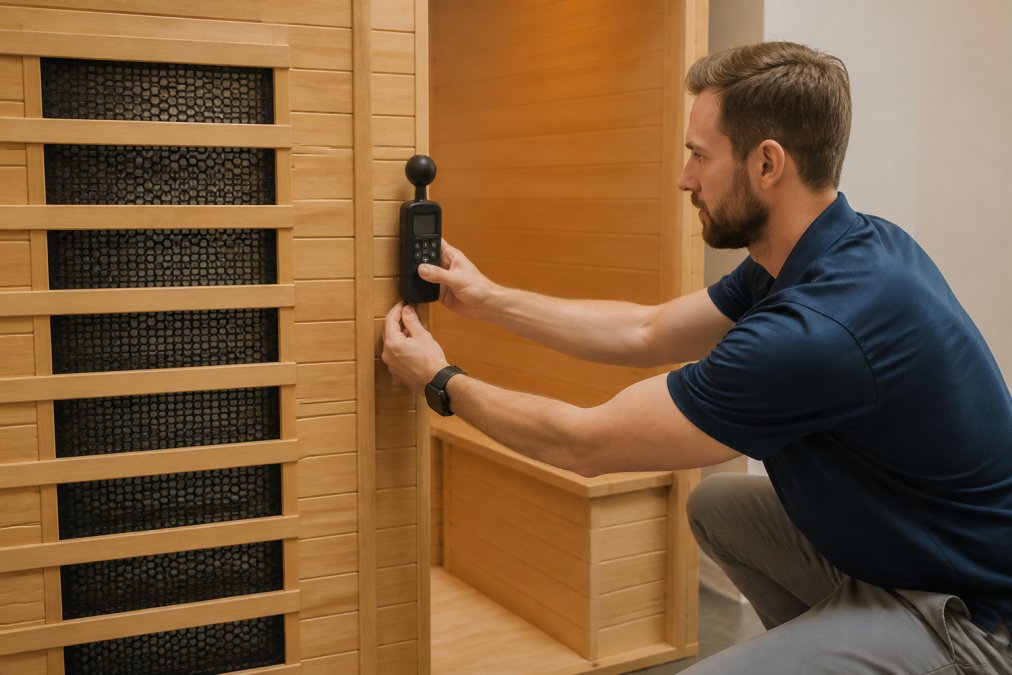
Infrared saunas have become popular for home wellness routines, but marketing claims about electromagnetic field (EMF) levels often lack substance. Many manufacturers tout "ultra-low EMF" without providing verifiable data. At Stack For Wellness, we believe buyers deserve transparent technical specifications and the tools to verify them independently. This guide walks you through how to verify low EMF sauna ratings before making a purchase. For example, our Infrared Sauna Built for Deep Heat Therapy, 6-Person Cedar, 10 Carbon Heaters, Ultra-Low EMF Design provides transparent technical details like its 10 carbon heaters and ultra-low EMF design.

Understanding EMF claims and how to test them yourself separates informed buyers from those relying on marketing language alone. With the right meter and clear methodology, anyone can verify a manufacturer's claims.
Understanding EMF vs. ELF in Infrared Saunas
EMF stands for electromagnetic fields. ELF stands for extremely low frequency. These terms describe different aspects of the same phenomenon, and understanding the distinction matters when evaluating sauna specifications.
Electromagnetic fields exist wherever electricity flows. In an infrared sauna, the heater panels generate both electric and magnetic fields as they operate. Electric fields are measured in volts per meter (V/m). Magnetic fields are measured in milligauss (mG), a unit of magnetic flux density.
ELF refers specifically to frequencies below 300 hertz (Hz). Most household appliances and electrical systems operate in this range. When manufacturers talk about "low EMF" saunas, they're usually referring to low ELF magnetic field exposure, the magnetic fields produced at extremely low frequencies.
The confusion arises because EMF is a broad category that includes both electric and magnetic components. A sauna can have low magnetic fields but measurable electric fields, or vice versa. Responsible manufacturers provide both measurements.
Why Marketing Claims About Low EMF Often Mislead
Many saunas advertise "ultra-low EMF" without providing actual measurements or testing data to back up the assertion.
Common misleading claims lack specificity: What's the actual measurement? At what distance was it taken? Which testing standard was applied?
Some manufacturers cite third-party testing without making the full report available, or reference safety standards without clarifying whether their product meets them. Others quote measurements from the heater panel in isolation, ignoring the field at the seating area where users actually sit.
The most honest approach is straightforward: a manufacturer should provide actual test results, specify the measurement distance and methodology, name the testing organization, and explain what the numbers mean relative to established safety guidelines. Stack For Wellness prioritizes this transparency because buyers deserve facts, not marketing rhetoric. Our Infrared Sauna Built for Deep Heat Therapy, 6-Person Cedar, 10 Carbon Heaters, Ultra-Low EMF Design, for instance, features an ultra-low EMF design and is ETL Listed.
How to Use an EMF Meter for Saunas
Measuring EMF yourself requires the right equipment and a clear process. A tri-axial EMF meter, one that measures fields in three dimensions simultaneously, is the standard tool for this work. These meters are affordable and straightforward to use.
Choosing the Right Meter
A tri-axial meter measures magnetic fields in all three spatial axes at once, giving a complete picture rather than a single directional reading. Single-axis meters can miss significant portions of the field if the orientation is wrong.
Look for meters with a frequency range that covers ELF (up to 400 Hz or higher) and displays readings in milligauss (mG) or microtesla (µT). Avoid RF (radiofrequency) meters, which measure different fields entirely.
Measurement Placement and Distance
EMF levels drop significantly with distance from the source, so measuring location matters.
Measure at the heater panel surface, at 12 inches away, and at 24 inches away to show how the field diminishes with distance.
Position the meter where a user would sit during a session. If the sauna has multiple heater panels, test near each one.
Take measurements with the sauna running at operating temperature and note the operating mode when recording results.
Recording and Comparing Results
Record the location, distance from the heater, date, sauna model, and operating conditions to compare against manufacturer claims.
Compare your measurements to published safety guidelines. The International Commission on Non-Ionizing Radiation Protection (ICNIRP) provides reference levels for general public exposure.
A commonly cited threshold for general public exposure to ELF magnetic fields is 200 mG (or 20 µT). Your measurements will confirm or contradict manufacturer claims.
If your readings differ significantly from the manufacturer's stated levels, request their testing report, the date it was conducted, and the methodology used.
Infrared Sauna EMF Testing Standards and Thresholds
The ICNIRP guidelines provide a reference level for general public exposure of 200 mG of ELF magnetic field exposure.
Many sauna manufacturers aim for levels below 3 mG at the seating area, a safety margin well below published guidelines.
The European Union and Australia follow ICNIRP guidance. The United States does not have a federal EMF exposure limit for the general public.
A sauna measuring below 3 mG at seating distance offers a margin. Readings between 3 and 50 mG are within published guidelines. Anything above 200 mG is a higher level.
What to Request From Manufacturers
Request a copy of the full testing report, not just a summary or marketing claim. The report should include the measurement distance, the frequency range tested, the date of testing, and the name of the testing organization. A reputable manufacturer will provide this without hesitation.
Ask whether measurements were taken at the heater panel surface or at the seating area; readings at the seating area are more meaningful.
Inquire about the testing methodology: Was the sauna running at full power or typical operating temperature? Were multiple heater panels tested?
Ask whether the manufacturer has had the sauna independently tested by a third party; third-party testing carries more weight because the testing organization has no financial stake in the results.
Third-Party Testing and Certification
Look for saunas tested by recognized labs or testing organizations. These reports should be publicly available or provided to prospective buyers.
Certification means the product meets a specific standard. ETL (Electrical Testing Laboratories) certification verifies electrical safety but doesn't specifically address EMF levels.
A testing report from a qualified lab is more valuable than a certification label because it provides actual measurements.
Ask the manufacturer whether they've had their sauna tested by an independent lab. A manufacturer confident in their EMF performance should be willing to invest in third-party verification.
The Role of Grounding, Wiring, and Sauna Construction
EMF levels depend on more than just the heater panels. The way the sauna is grounded, wired, and constructed affects the fields it produces.
Proper grounding is essential. A sauna with correct grounding will have lower electric fields because the ground plane dissipates charge. When evaluating a sauna, ask about the grounding system and whether the metal frame is properly grounded.
Wiring layout matters: looped wiring can amplify magnetic fields, while shielded or twisted wiring reduces them.
The materials used in construction also play a role. Conductive materials like metal can shield fields or, if improperly installed, amplify them. Cedar wood, commonly used in sauna cabins, is non-conductive and doesn't shield fields. Some manufacturers use additional shielding materials, though this adds cost.
Distance from the heater panels to the seating area is a practical factor. A sauna with heaters positioned farther from where users sit will naturally have lower field levels at the seating position. Cabin design influences this distance.
When comparing saunas, consider the whole construction. A sauna with quality grounding, thoughtful wiring, and good heater placement will outperform one designed with cost as the only priority.
How to Verify Low EMF Sauna Ratings Before Purchase
Verification requires a combination of research, measurement, and critical thinking about the claims you encounter.
Start by requesting the manufacturer's EMF testing data before you buy. Don't accept vague assurances. Ask for specific measurements, the testing methodology, and the date of testing. If the manufacturer won't provide this information, that's a red flag.
If possible, measure the sauna yourself before finalizing your purchase. Many retailers allow testing in the showroom. Bring your tri-axial meter and take readings at the seating area with the sauna operating at normal temperature. Compare your measurements to the manufacturer's claims.
Research the manufacturer's reputation.
Frequently Asked Questions
What is the difference between EMF and ELF in sauna specifications?
EMF (electromagnetic field) is the general term for electric and magnetic fields. ELF (extremely low frequency) refers specifically to fields below 300 Hz, which is the frequency range most infrared sauna heaters operate in. When manufacturers claim 'low EMF' or 'ultra-low EMF,' they're typically referring to ELF magnetic field output measured in milligauss (mG). Understanding this distinction helps you interpret technical specs accurately and avoid confusing marketing language with actual safety data.
How can I independently test the EMF output of my sauna?
Use a tri-axial EMF meter to measure magnetic field strength in milligauss. Take measurements at the seating area, 12 inches from heater panels, and at various distances from the sauna body. Record readings with the sauna at operating temperature. Compare your results to manufacturer specifications and third-party test reports. Calibrate your meter annually for accuracy. Many infrared saunas aim for readings below 3 mG at seating distance when properly constructed and grounded.
What technical documentation should I request to verify EMF ratings?
Request the manufacturer's third-party EMF test report from an independent lab, which should include measurement methodology, specific distances tested, heater specifications, and certification details. Ask for the lab's accreditation and the testing standard used. Request the sauna's grounding and wiring diagram, heater panel specifications including frequency range, and any ETL or safety listing documentation. Legitimate manufacturers provide this data readily; vague responses or unavailable reports are indicators to consider.
Are all infrared heaters the same in terms of electromagnetic field output?
No. Carbon heaters, ceramic heaters, and metal-coil heaters produce different EMF signatures based on their construction, frequency range, shielding, and wiring. Some infrared saunas use shielded carbon or ceramic panels with proper grounding to influence field levels. Construction materials, cabinet grounding, and electrical wiring design also affect total EMF exposure. This is why two saunas with similar wattage can have very different measured EMF levels at the seating area. Specifications matter more than price alone.
Meta Title: How to Verify Low EMF Sauna Ratings: A Buyer's Guide to EMF Testing
Meta Description: Learn how to verify low EMF sauna claims using a tri-axial meter. Understand testing standards, measurement distances, and what to request from manufacturers before buying.