Best Infrared Sauna for Home Recovery: 2026 Guide
Table of Contents
- What Separates a Recovery Sauna From a Basic One
- Infrared Sauna Health Benefits for Athletes
- How Long to Stay in an Infrared Sauna for Recovery
- Low EMF Infrared Sauna Brands and What to Verify
- Electrical Requirements and Installation Planning
- Size, Capacity, and Long-Term Maintenance Costs
- Frequently Asked Questions
Last Updated: September 19, 2026
What Separates a Recovery Sauna From a Basic One
A best infrared sauna for home recovery is built around three measurable specs: heater type and count, wood species, and electromagnetic field (EMF) output. Get those wrong and you own an expensive warm box. Get them right and you own a recovery tool you will use four or five times a week.
Stack For Wellness publishes technical specifications for every unit it sells, including heater count, wood species, and EMF ratings, because those three numbers decide whether a sauna supports real recovery or just feels hot. This guide covers what matters, what to verify before you buy, and where shoppers get misled.
Heater Technology and Heat Distribution
Infrared saunas use one of two heater types: carbon panel heaters or ceramic rod heaters. Carbon heaters spread heat across a wide surface for gentler, more even warmth. Ceramic heaters run hotter and warm up faster, but concentrate heat in narrow zones.
Heater count matters more than heater type for even heat distribution. A cabin with six to eight carbon panels heats the shoulders, back, and legs at similar temperatures.
Wood Quality and Off-Gassing Concerns
Cedar and hemlock are the two woods you will see most often, and the choice affects durability and air quality. Cedar resists moisture and carries a natural aroma but costs more. Hemlock is lighter, less expensive, and performs well in dry indoor rooms.
Infrared Sauna Health Benefits for Athletes
Infrared sauna health benefits for athletes center on three outcomes: faster post-workout recovery, better circulation, and lower resting stress load. Infrared energy raises core tissue temperature, which increases blood flow to working muscles and helps clear metabolic byproducts from training.
Muscle Recovery and Circulation Improvement
Muscle recovery depends on blood flow, not heat alone. Infrared heat dilates blood vessels and increases circulation to the warmed tissue, speeding delivery of oxygen and nutrients while helping clear waste products. That is why post-workout protocols pair sauna use with hydration and adequate protein.
How Long to Stay in an Infrared Sauna for Recovery
The answer to how long to stay in an infrared sauna for recovery is 20 to 30 minutes per session at 120 to 140°F. Beginners should start at 15 minutes and add five minutes per session over the first two weeks.
| Goal | Temperature | Session Duration | Frequency |
|---|---|---|---|
| Post-workout recovery | 130-140°F | 20-30 min | 3-5x per week |
| Joint pain relief | 120-130°F | 25-30 min | 4-5x per week |
| Stress reduction | 110-125°F | 20-25 min | Daily |
| Pre-workout warm-up | 110-120°F | 10-15 min | Before training |
Low EMF Infrared Sauna Brands and What to Verify
Low EMF infrared sauna brands should publish a specific milligauss (mG) rating, not a vague "low EMF" claim. The standard to look for is under 3 mG at the seating position, measured at the point where your body actually sits.
Electrical Requirements and Installation Planning
Electrical planning is the step most buyers skip until the sauna is in the driveway, and it is the most common reason a delivery gets delayed. Infrared cabins are resistive-heat appliances that pull a steady, continuous load for 20 to 40 minutes at a time, a harder draw than a space heater that cycles on and off. That continuous load is why the National Electrical Code treats fixed heating appliances under continuous-load rules, and why most manufacturers specify a dedicated circuit.
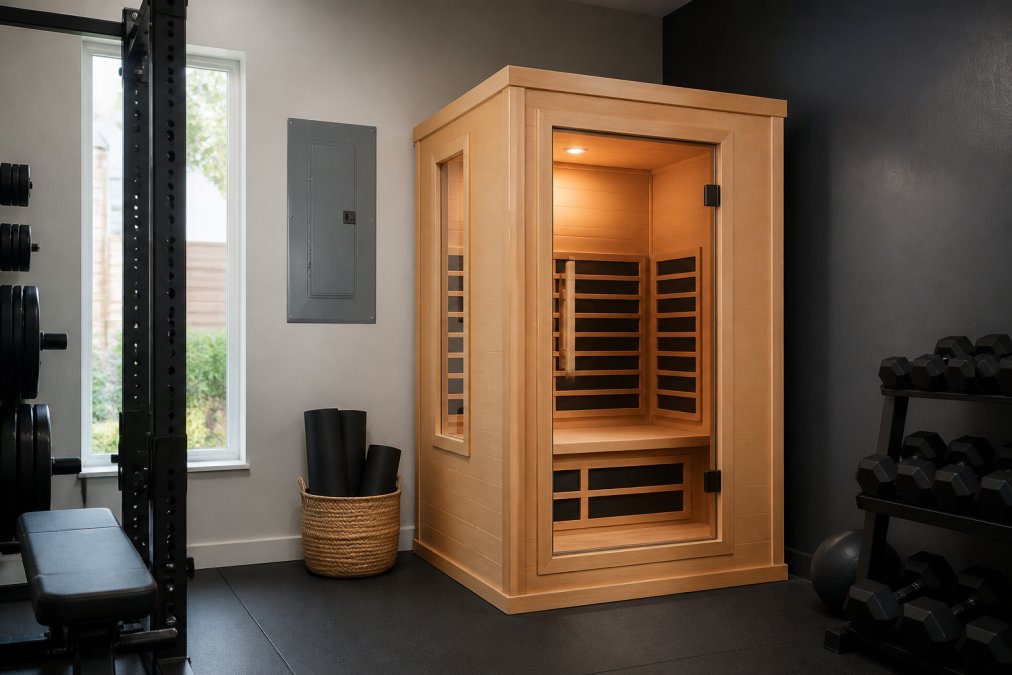
How to Check Whether Your Panel Can Support the Sauna
Before you buy, walk to your electrical panel and answer three questions:
- Is there a spare breaker slot? A 240V cabin needs two adjacent open slots for a double-pole breaker. A 120V cabin needs one.
- What is the panel's total service amperage? Most modern homes run 200-amp service, which usually has room. Older homes with 100-amp service may not, especially if the panel already feeds an electric range, dryer, and central air.
- How far is the run from the panel to the sauna location? Wire gauge is sized by both amperage and distance. A 60-foot run needs heavier wire than a 15-foot run for the same load, and that changes the material cost.
Placement Decisions That Affect the Electrical Work
Where you put the cabin changes the electrical scope more than any other choice. A sauna against the same wall as the panel is the cheapest install. A detached garage or outdoor pad may require a subpanel, a GFCI-protected circuit, and environment-rated conduit, plus grounding and GFCI requirements indoor installs do not have.
Do not plug a 120V cabin into a shared bedroom circuit and assume it will be fine because it "only" draws 15 amps. A 15-amp draw on a 15-amp circuit with a lamp, a phone charger, and a TV on the same line will trip the breaker, and repeated tripping is hard on both the heater elements and the breaker itself.
Indoor vs. Outdoor Placement
Indoor placement is simpler for most homes. A basement, spare bedroom, or garage corner works if the floor is level and the room has ventilation. Ambient temperature affects warm-up time, so a heated indoor space outperforms a cold garage.
The installation decision that causes the most regret is skipping the dedicated circuit. Buyers assume a standard outlet will work, then discover the cabin trips the breaker every session. Confirm the amperage draw and the circuit requirement before delivery, not after.
Size, Capacity, and Long-Term Maintenance Costs
Size and capacity should match your actual use, not your imagined use. A one-person cabin fits a condo recovery corner. A two-person cabin is the practical minimum if you want to stretch out or share sessions. Three-person cabins need real floor space and a 240V circuit.
Electricity Consumption: The Math You Can Actually Run
Electricity cost is the easiest recurring cost to estimate: kilowatts × hours × your utility rate. A cabin drawing 1,500 watts uses 1.5 kilowatts per hour, so a 30-minute session uses 0.75 kilowatt-hours, a few cents to roughly a quarter per session at typical residential rates.
Replacement Parts and Their Service Life
Budget for these recurring items:
- Heater replacement: carbon panel heaters are the most common failure point and typically last several years of regular use before output drops; ceramic rod heaters vary more widely by brand and build quality. Replacement panels are sold individually, and the cost scales with cabin size.
- Wood conditioning: cedar and hemlock benefit from periodic treatment to prevent drying and cracking. Cedar holds up better in humid rooms; hemlock needs more attention in the same conditions.
- Electrical inspection: an annual check of the dedicated circuit and connections is cheap insurance, especially on a 240V install.
- Filters and vents: if your cabin includes air purification, those components need periodic replacement, and the filters are usually proprietary.
Placement affects all four. A humid basement accelerates wood wear, a dusty garage clogs vents faster, and a climate-controlled indoor room keeps every component closer to its expected service life.
Warranty Terms Are Part of the Cost Equation
Warranty coverage varies widely by brand and component. Heaters, controls, and the wood structure are often covered on different schedules, and the heater, the part most likely to fail, frequently has the shortest term. Read the warranty document, not the marketing bullet, and check whether labor is covered or parts only; a five-year parts-only heater warranty differs in value from a three-year warranty that includes labor.
The cheapest way to protect your total cost of ownership is to keep the cabin in a climate-controlled room and run it on a consistent schedule. Saunas that sit unused for months and then get run hard tend to show wood and heater problems sooner than saunas used a few times a week.
Frequently Asked Questions
What are the health benefits of infrared saunas for muscle recovery?
Infrared saunas use therapeutic heat to raise core body temperature, which increases blood flow and helps flush metabolic waste from muscles after exercise. For athletes, this means faster post-workout recovery, reduced joint pain, and improved circulation. The deep-penetrating far-infrared wavelengths reach muscle tissue more effectively than traditional sauna steam, making sessions shorter and more targeted. Many users report less soreness within 24 hours of a session.
How do I choose the right infrared sauna for my home?
Start with your available space and electrical capacity. Measure your room, confirm whether you have a 120V or 240V outlet available, and decide between indoor and outdoor placement. Then evaluate heater type (carbon vs. ceramic), EMF rating (look for sub-3 mG at typical seating distance), and wood species. Full-spectrum models include near-infrared for skin and surface-level benefits, while far-infrared targets deep muscle tissue. Match the sauna to your recovery goals and installation constraints.
Are infrared saunas worth the investment for home recovery?
For people who use them consistently, yes. The value comes from frequency: a sauna you use four or five times a week delivers compounding recovery benefits that occasional spa visits cannot match. Consider the long-term maintenance costs, including replacement heaters and wood care, alongside the upfront price. If you have a dedicated recovery space and a clear routine, a home infrared sauna becomes a practical daily tool rather than a luxury purchase.
Do infrared saunas emit high levels of EMF?
EMF output varies by manufacturer and heater design. Quality saunas publish their EMF readings, typically measured in milligauss (mG) at seating distance. Look for models that test below 3 mG at the bench and backrest, which is the standard many low-EMF brands cite. Ask for third-party test results rather than relying on marketing claims. Heater wiring, control panel placement, and overall build quality all affect EMF levels.
Choosing the right unit comes down to matching specs to your actual recovery routine, not chasing the longest feature list. Stack For Wellness builds curated home recovery systems with published heater counts, wood species, and EMF ratings, so you can compare units on verifiable data instead of marketing claims. Shop now to build a recovery setup where every piece is selected to work with the others.