


How to Build a Wellness Sanctuary: A Complete Guide
Table of Contents
- Defining Your Wellness Sanctuary
- Essential Home Wellness Equipment for Your Recovery Space
- Infrared Sauna Installation Requirements and Setup
- Home Recovery Room Layout Ideas and Spatial Planning
- Cold Plunge Maintenance Guide and Water Care
- Integrating Smart Technology and Sensory Design
- Creating Your Intentional Wellness Ritual
- Frequently Asked Questions
Last Updated: September 30, 2026
How to Build a Wellness Sanctuary: A Complete Guide
A dedicated wellness sanctuary at home transforms how you approach relaxation and recovery. Whether you're building for post-workout routines, relaxation, or intentional self-care, a wellness sanctuary offers consistent access to equipment and space designed specifically for your needs. This guide walks you through every step of building a wellness sanctuary that fits your space, budget, and lifestyle.
Defining Your Wellness Sanctuary
A wellness sanctuary is a dedicated personal space outfitted with complementary equipment designed for relaxation and intentional wellness routines. Unlike scattered equipment in a spare room, a true sanctuary combines thoughtful spatial planning, quality equipment, and sensory design to create an environment where your practice becomes consistent.
The core difference lies in intentionality. A sauna positioned in a designed recovery space, paired with complementary equipment and a planned routine, becomes part of a daily practice rather than unused equipment in a basement.
Your wellness sanctuary doesn't require a dedicated room. A garage corner, basement section, or covered outdoor area works well. What matters is that the space feels intentional, organized, and inviting enough that you'll use it consistently.
Essential Home Wellness Equipment for Your Recovery Space
The most effective sanctuaries combine multiple modalities, heat, cold, light, and targeted comfort, rather than relying on a single tool.

Infrared Saunas: Heat and Relaxation
Infrared saunas use carbon or ceramic heaters to emit wavelengths that warm your body directly, allowing lower ambient temperatures (typically 120-140°F) while delivering penetrating heat.
Prefabricated saunas are most practical for residential spaces.
Cold Plunges: Contrast and Invigoration
A quality cold plunge maintains water temperature between 37-39°F without constant ice replenishment. The Modtub 2.0 Cold Plunge System uses a quarter-horsepower chiller with 3,010 BTU cooling capacity, rotomolded LLDPE tub with shoulder-level water depth, and 50-micron filtration.
Red Light Therapy Panels: Wavelength-Based Wellness
The Hooga ULTRA1500 Full Body Red & Near Infrared Light Panel delivers 300 quad-chip LEDs (630nm, 660nm, 810nm, 850nm wavelengths) across a 3.5-foot panel with 60-degree beam angle, adjustable brightness, timer settings, and mounting options.

Massage Chairs: Targeted Comfort
The M9 3D Full Body Massage Chair uses 3D rollers (up to 3 inches depth), SL-track from neck to lower back, zero-gravity recline, and AI body scan that adjusts roller position based on height.

Infrared Sauna Installation Requirements and Setup
An infrared sauna drawing 2,700 watts at 240V requires a dedicated 20-amp circuit; you cannot share this circuit with other appliances.
Home Recovery Room Layout Ideas and Spatial Planning
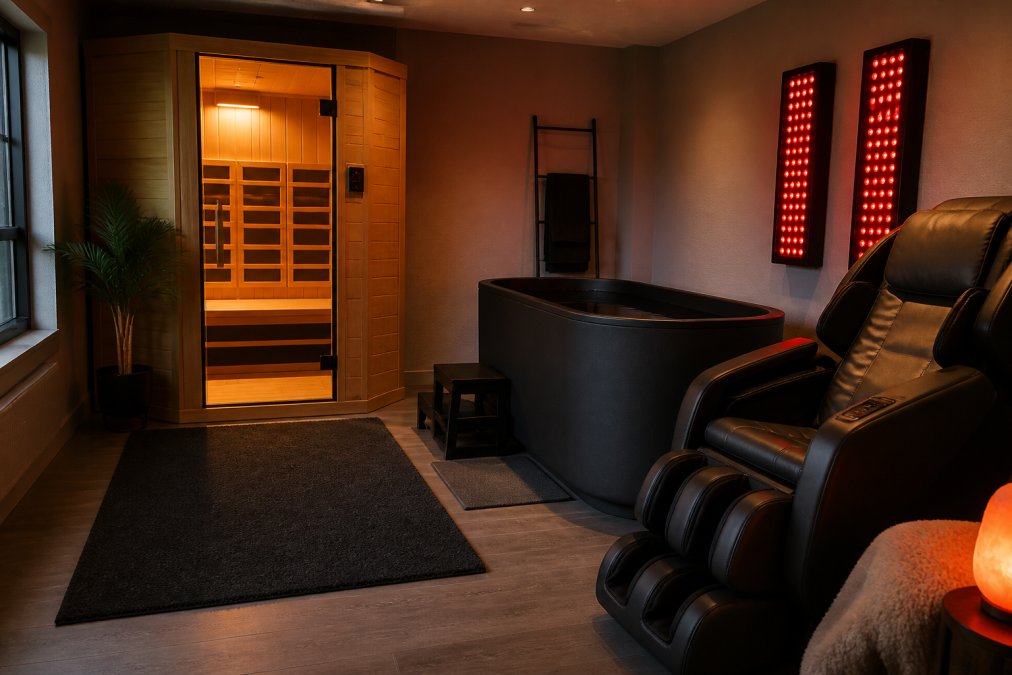
Effective layout balances equipment spacing, traffic flow, and accessibility to create an inviting space you'll use regularly.
| Layout Element | Purpose | Placement Tip |
|---|---|---|
| Sauna | Heat-based relaxation | Corner position, 12" clearance on all sides |
| Cold plunge | Contrast and invigoration | Adjacent to sauna, 10-15 feet away |
| Massage chair | Post-session comfort | Offset angle, clear sightline to relaxation area |
| Light panels | Wavelength-based sessions | Wall-mounted, 6-12" body distance |
| Flooring | Comfort and safety | Rubber tiles or moisture-resistant mat |
| Lighting | Ambiance and function | Dimmable warm LEDs, 2700K color temp |
| Ventilation | Air quality | Open windows or inline exhaust fan |
Cold Plunge Maintenance Guide and Water Care
Consistent maintenance keeps water clean and the chiller functioning reliably.
Infrared Sauna Built for Deep Heat →
Integrating Smart Technology and Sensory Design
Smart home integration can automate routine setup and enhance usability without complex programming.
Creating Your Intentional Wellness Ritual
Natural materials (cedar sauna, wood flooring), natural light, and views of plants enhance the sanctuary experience. If your recovery room lacks windows, add nature photography or a living wall.
Frequently Asked Questions
What equipment is essential for a home wellness sanctuary?
A cohesive wellness sanctuary typically includes an infrared sauna for heat-based relaxation, a cold plunge for contrast sessions, red light therapy panels for wavelength-based wellness, and a massage chair for targeted comfort. These four categories work together to create a complete recovery environment. Start with one or two pieces that align with your space and budget, then expand as your sanctuary grows. The key is selecting equipment with compatible specifications and complementary uses so each piece enhances your overall wellness routine.
How much space do I need to build a home wellness sanctuary?
Space requirements depend on your equipment choices. A 6-person infrared sauna requires roughly 6'3" wide by 4'11" deep. A cold plunge system needs about 75 inches of length total (tub plus chiller). A full-body massage chair requires 69 inches when reclined and 3.9 inches of wall clearance. A red light therapy panel can hang on any wall. For a complete sanctuary, a dedicated room of 200-400 square feet allows comfortable placement of all four equipment types with space to move between sessions. Smaller spaces can work with a strategic layout, prioritize what matters most to your routine.
What are the electrical requirements for home recovery equipment?
Electrical needs vary by equipment. An infrared sauna like the HeatWave Great Bear draws 240V, 20A, and 2,700 watts. A cold plunge chiller runs on standard 110V household current. Red light therapy panels typically use 110V with standard outlets. A massage chair also uses standard 110V. Before installing, verify your home's electrical panel has sufficient capacity for simultaneous use, and consider consulting a licensed electrician if adding a dedicated 240V circuit for the sauna. Proper electrical planning prevents overloads and ensures safe, reliable operation.
How do I choose the right materials for a home sauna?
Material choice affects durability, aroma, and heat performance. Canadian Red Cedar is prized for its natural rot resistance, aromatic qualities, and excellent heat insulation. It's the standard for premium infrared saunas because it withstands humidity and temperature cycles without degrading. Tongue-and-groove joinery ensures structural integrity over years of use. The interior surfaces should be smooth and splinter-free for comfort during sessions. When evaluating saunas, check the wood species, joinery method, and whether the construction includes features like adjustable roof vents for air circulation and long-term structural stability.
What is the best way to organize a home recovery room?
Organize your recovery room by session flow and spatial efficiency. Position your infrared sauna in a corner or against a wall to anchor the space. Place the cold plunge nearby but separate enough to allow movement between heat and cold sessions. Mount red light therapy panels on walls or stands where they align with where you'll stand or recline. Position your massage chair where it has full recline space and can face a window or calming view if possible. Create distinct zones for each activity so transitions feel intentional. Include ambient lighting, air quality management, and acoustic comfort to support mindfulness during each session.
Can a wellness sanctuary fit in a small space or apartment?
Yes, with strategic planning. A massage chair positioned 3.9 inches from a wall can fit in a bedroom corner. A cold plunge system has a compact footprint and can sit on a patio, garage, or spare room. A full-body red light therapy panel hangs on any wall without floor space. An infrared sauna requires more room but models exist in different sizes. If space is limited, prioritize the equipment that aligns most with your routine, then expand as opportunity allows. Stack For Wellness can help you design a layout that works within your actual dimensions.
How do I maintain a cold plunge system long-term?
Cold plunge maintenance centers on water quality and chiller operation. The Modtub 2.0 uses a 50-micron pleated filter with bypass valves to keep water clean between full changes. Check and rinse the filter regularly, and plan to drain and refill the tub every 1-3 months depending on use frequency and local water quality. The quarter-horsepower chiller maintains 37-39°F automatically; ensure it has clear airflow and runs on a stable electrical supply. An insulated lid seals the tub between sessions, reducing chiller workload and keeping water clean. Follow the manufacturer's care guide for your specific model to maximize equipment lifespan.
Is a home wellness sanctuary worth the investment?
A wellness sanctuary's value depends on your commitment to consistent use and your lifestyle needs. Unlike a gym membership or spa visits, home equipment is always available, eliminating barriers to regular sessions. A curated system designed to work together compounds the value of each piece, you use them more consistently because they're integrated and accessible. For busy professionals, athletes, and anyone prioritizing daily relaxation and recovery routines, the convenience and long-term cost-per-use often justifies the initial investment. Start with one or two pieces and assess your actual usage before expanding.
Meta Title: How to Build a Wellness Sanctuary: Complete Equipment & Design Guide
Meta Description: Learn how to design and build a home wellness sanctuary with infrared saunas, cold plunges, massage chairs, and light therapy. Step-by-step layout, installation, and maintenance guide.






