Sauna and Cold Plunge Benefits: A Complete Guide
Table of Contents
- What Is Contrast Therapy and Why Combine Sauna With Cold Plunge
- The Science Behind Sauna and Cold Plunge Benefits
- How Long to Stay in Sauna Before Cold Plunge: Timing and Duration
- Benefits of Contrast Therapy for Recovery and Performance
- Building Your Contrast Therapy Protocol at Home
- Choosing Equipment: Sauna and Cold Plunge for Your Space
- Common Mistakes and Safety Considerations
- Frequently Asked Questions
Last Updated: September 21, 2026
What Is Contrast Therapy and Why Combine Sauna With Cold Plunge
Contrast therapy is the practice of alternating between heat and cold exposure to trigger specific physiological responses. You move from a sauna's warmth to a cold plunge's chill, then back again. This cycle activates your body's natural recovery systems in ways neither heat nor cold alone can achieve.

This pairing works because it forces your cardiovascular system to adapt. Heat dilates blood vessels; cold constricts them. That repeated cycle trains your circulatory system and activates cellular repair mechanisms, more powerful than either therapy alone.
The results compound. Thousands of fitness enthusiasts have made this a core part of their routines because they feel the difference.
The sauna cold plunge benefits show up in three main areas: physical recovery, mental clarity, and cardiovascular adaptation. Below, we'll show you exactly how these work and how to build a protocol that fits your goals.
The Science Behind Sauna and Cold Plunge Benefits
Heat Shock Proteins and Cellular Repair
Heat exposure triggers cells to produce heat shock proteins, repair crews that fix damaged proteins, reduce inflammation, and trigger cellular cleanup. Cold amplifies this response, creating a stronger stimulus than heat alone. Recovery kinetics improve when you use both therapies.
Norepinephrine, Growth Hormone, and Hormonal Response
Cold exposure triggers norepinephrine release, sharpening focus and reducing inflammation. Heat stimulates growth hormone release, supporting muscle recovery and metabolism. Combined, you get both hormonal benefits in one session. Sauna first, then cold plunge can amplify the norepinephrine response.

Regular contrast therapy trains your autonomic nervous system: the sympathetic nervous system (fight-or-flight) activates during cold, the parasympathetic (rest-and-digest) during heat, both responding more efficiently over time.
Vasodilation, Vasoconstriction, and Blood Flow
Contrast therapy forces repeated vasodilation (blood vessels widen) and vasoconstriction (narrow), training your circulatory system. This pumping action flushes metabolic waste and delivers oxygen more efficiently. Over time, cardiovascular endurance improves. Better blood flow removes inflammatory byproducts faster, decreasing delayed onset muscle soreness (DOMS).
How Long to Stay in Sauna Before Cold Plunge: Timing and Duration
The ideal sauna duration before a cold plunge is 12-20 minutes, allowing core body temperature to rise and trigger heat shock protein production. Staying longer than 20 minutes can be counterproductive, causing excessive stress instead of beneficial adaptation.

Here's the timing breakdown:
| Phase | Duration | Purpose |
|---|---|---|
| Warm-up in sauna | 3-5 minutes | Acclimate to heat |
| Main sauna session | 10-15 minutes | Build core temperature, trigger heat shock proteins |
| Transition to cold | 1-2 minutes | Cool down slightly, prepare mentally |
| Cold plunge | 2-5 minutes | Trigger norepinephrine, activate vasoconstriction |
| Recovery rest | 5-10 minutes | Allow heart rate to normalize, let hormones settle |
Start cold plunges at 2-3 minutes; advanced users go to 5 minutes. Beyond 5 minutes, stress becomes excessive. Colder water and hotter saunas require shorter durations.
Benefits of Contrast Therapy for Recovery and Performance
Reduced Muscle Soreness and Faster Recovery Kinetics
Contrast therapy reduces post-workout inflammation through improved blood flow, heat shock proteins, norepinephrine, and repeated vasodilation/vasoconstriction. People report less soreness 24-48 hours after workouts and faster recovery.
Mental Clarity, Focus, and Stress Resilience
Cold exposure triggers norepinephrine release. This hormone sharpens focus and improves mood. The effect lasts hours after the cold plunge.
Heat exposure is deeply relaxing. The parasympathetic nervous system activates. Stress hormones drop. Mental fatigue decreases.
When you combine them, you get both effects:
- Cold plunge: acute mental clarity, improved focus
- Sauna: deep relaxation, stress reduction
- Regular practice: improved stress resilience overall
Your nervous system adapts to handle stress better. Cortisol (stress hormone) levels stabilize. Anxiety decreases. Sleep quality improves.
Many people report that contrast therapy is one of the best tools for managing stress.
Cardiovascular Endurance and Systemic Inflammation
Your heart adapts to contrast therapy. The repeated vasodilation and vasoconstriction train your cardiovascular system to respond more efficiently.
Over weeks, you'll notice:
- Lower resting heart rate
- Faster heart rate recovery after exercise
- Better blood pressure regulation
- Improved cardiovascular endurance
Systemic inflammation also decreases. This benefits your entire body. Joint pain decreases. Energy levels improve. Recovery from illness speeds up.
The effect is cumulative. One session helps.
Building Your Contrast Therapy Protocol at Home
Beginner Protocol: Starting Safe and Sustainable
If you're new to contrast therapy, start simple. Too much too fast causes excessive stress instead of adaptation.
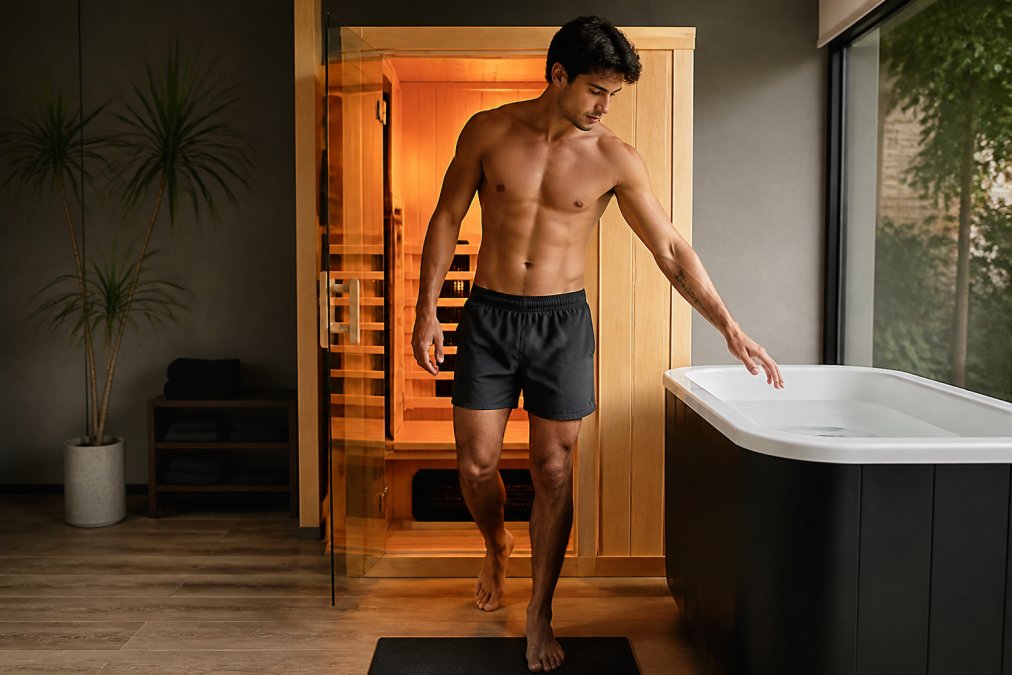
Week 1-2: Foundation Building
- Sauna: 10 minutes at 160-170°F
- Rest: 2 minutes (cool down, breathe)
- Cold plunge: 1-2 minutes at 50-55°F
- Recovery: 10 minutes rest
- Frequency: 1-2 times per week
This protocol lets your body adapt without overwhelming stress. You'll feel the benefits immediately. Energy improves. Sleep quality increases.
1-Person Red Cedar Far Infrared Sauna →
Week 3-4: Gradual Progression
- Sauna: 12-15 minutes at 170-180°F
- Rest: 2 minutes
- Cold plunge: 2-3 minutes at 45-50°F
- Recovery: 10 minutes rest
- Frequency: 2-3 times per week
By week 4, you'll notice faster recovery from workouts. Muscle soreness decreases. Mental clarity improves.
Advanced Protocol: Optimizing for Specific Goals
Once you're comfortable with basic contrast therapy, you can customize your protocol based on what you're trying to achieve.
For Muscle Recovery and Hypertrophy:
- Sauna: 15-18 minutes at 180-190°F
- Rest: 2 minutes
- Cold plunge: 3-4 minutes at 39-45°F
- Repeat cycle: 2 times (sauna → cold → rest)
- Frequency: 2-3 times per week, ideally post-workout
- Goal: Maximize growth hormone release while reducing inflammation
This protocol works best after strength training. The extended sauna session triggers maximum growth hormone release. The cold plunge reduces inflammation without suppressing the hormonal response.
For Mental Clarity and Stress Reduction:
- Sauna: 12 minutes at 160-170°F
- Rest: 2 minutes
- Cold plunge: 2-3 minutes at 48-52°F
- Single cycle (no repeat)
- Frequency: 3-4 times per week
- Goal: Maximize norepinephrine and parasympathetic activation
This protocol emphasizes nervous system training.
For Cardiovascular Adaptation:
- Sauna: 15 minutes at 175-185°F
- Rest: 1 minute (minimal recovery)
- Cold plunge: 4-5 minutes at 37-42°F
- Repeat cycle: 2-3 times
- Frequency: 2 times per week
- Goal: Train cardiovascular system through repeated vasodilation/vasoconstriction
Choosing Equipment: Sauna and Cold Plunge for Your Space
Home equipment quality matters. Mismatched systems don't work well together. Stack For Wellness solves this by curating equipment that complements each other.
For saunas, infrared models offer advantages over traditional saunas:
- Lower operating temperature (140-180°F vs. 160-210°F)
- Deeper tissue penetration
- Lower energy costs
- Easier to maintain
For cold plunges, three main options exist:
-
Inflatable systems (portable, affordable): The Drift Inflatable Cold Plunge with Cooling Unit ($2,309) lets you set up anywhere. It holds temperature without ice. The 1 HP chiller maintains 37-39°F. You control it from your phone.
-
Rigid tubs (permanent, durable): The Modtub 2.0 Cold Plunge System ($3,199) is deeper than most. You sit submerged to the shoulders. The quarter-horsepower chiller is quiet and reliable. It's made in the USA from the same material used for kayaks.
-
Premium systems (advanced features, higher cost): The RevX Acrylic X Tub Cold Plunge + LUX High Performance Chiller ($7,500) offers dual-temperature capability (34-104°F). You can use it for contrast therapy or warm water recovery. The 20-micron filtration system keeps water cleaner longer.
Common Mistakes and Safety Considerations
Mistake 1: Doing contrast therapy on an empty stomach
Your body needs fuel for the stress response. Eat a light meal 1-2 hours before. This stabilizes blood sugar and prevents dizziness.
Mistake 2: Staying in cold water too long
Mistake 3: Skipping the transition period
Mistake 4: Doing contrast therapy when sick or injured
Mistake 5: Using inconsistent water temperatures
Safety considerations:
- People with cardiovascular conditions should consult a doctor first
- Pregnant women should avoid cold plunges
- People on certain medications should check with their doctor
- Never do contrast therapy alone if you're new to it
- Hydrate well before and after
- Avoid alcohol before or after sessions
- Listen to your body; stop if you feel dizzy or unwell
Frequently Asked Questions
Should I cold plunge and sauna together, or use them separately?
Combining sauna and cold plunge in a contrast therapy protocol can offer recovery benefits. The alternating thermal stress can trigger hormonal responses. However, if you have cardiovascular concerns, consult a healthcare provider before starting.
How long should I stay in the sauna before a cold plunge?
Beginners should spend 10-15 minutes in the sauna to raise core body temperature adequately, then transition to a 2-3 minute cold plunge at 37-39°F. As you adapt, increase sauna time to 15-20 minutes and cold plunge duration to 3-5 minutes. The goal is thermal stress without overload. Listen to your body and avoid pushing beyond discomfort, especially in your first month of consistent contrast therapy.
What are the main benefits of contrast therapy for recovery?
Contrast therapy reduces delayed-onset muscle soreness (DOMS), improves blood flow and circulation, and improves stress resilience and mental clarity.
Can I do sauna and cold plunge every day?
Most people benefit from 3-4 contrast therapy sessions per week rather than daily use. If you're new to contrast therapy, start with 2 sessions weekly and progress gradually. Listen to signs of fatigue or elevated resting heart rate, which indicate you need more rest days.