


Choosing High Quality Recovery Equipment: 2026 Guide
Table of Contents
- Choosing High Quality Recovery Equipment: What the Spec Sheet Decides
- Quick Comparison: Recovery Equipment by Category and Price
- Infrared Sauna Buying Guide: Heaters, Wood, Power, and EMF
- Cold Plunge Buying Guide: Chiller Power, Filtration, and Footprint
- Red Light Therapy Panel Specifications That Actually Matter
- Home Recovery Room Setup: Space, Power, and Floor Load
- How to Inspect, Maintain, and Retire Recovery Equipment
- Conclusion: Buying Recovery Equipment as One System
- Frequently Asked Questions
Last Updated: October 17, 2026
Choosing High Quality Recovery Equipment: What the Spec Sheet Decides
Choosing high quality recovery equipment comes down to one habit: reading the specification sheet before the marketing copy. At Stack For Wellness, we sell infrared saunas, cold plunges, red light panels and massage chairs. Buyers who compare heater counts, chiller horsepower, wavelength listings and electrical draw end up with a room that works; buyers who shop on photos alone end up with mismatched gear.
A recovery equipment purchase is a system decision. A sauna that needs a 240 V circuit and a plunge that needs a dedicated 15 A outlet cannot share one wall socket, and a panel that hangs on a door needs clearance behind it.
This guide walks through the specifications that determine quality, category by category, plus the two things most buying guides skip: how to inspect and retire gear, and how to plan a room before you order.
Quick Comparison: Recovery Equipment by Category and Price
Recovery equipment splits into four categories, each with a different deciding specification. Saunas: heater count and wood species. Cold plunges: chiller horsepower and filtration. Light panels: wavelength and LED count. Massage chairs: roller system and wall clearance.
| Category | Model | Key Spec | Footprint or Draw | Price |
|---|---|---|---|---|
| Infrared sauna | SalusHEAT Sublime-901BR 1-Person | 8 low-EMF carbon panels, cedar | 35.5" x 35.5", 1,510 W | $2,289.00 |
| Infrared sauna | HeatWave Great Bear 6-Person | 10 carbon panels, 2,700 W | 6' 3" W x 4' 11" D | $5,329.99 |
| Cold plunge | Modtub 2.0 | ¼ HP chiller, 37-39°F | About 75" with chiller | $3,199.00 |
| Cold plunge | RevX Acrylic X Tub + LUX | 1.5 HP chiller, 34-104°F | 93" x 42" x 38" | $7,500.00 |
| Cold plunge | Drift Inflatable | 1 HP unit, 37.4°F | 53" x 31.5", packs down | $2,309.00 |
| Light panel | Hooga PRO1500 | 300 dual-chip LEDs | 42.5" x 12" x 8" boxed | $1,539.00 |
| Light panel | Hooga ULTRA1500 | 300 quad-chip LEDs | 42.7" x 12.2" x 8.1" boxed | $1,799.00 |
| Light panel | iReliev 2400W | 480 LEDs, 5 wavelengths | 51.6" x 18.4" x 3" | $1,795.95 |
| Massage chair | M9 3D Full Body | 3D rollers, SL-track | 3.9" wall clearance | $2,569.00 |
Infrared Sauna Buying Guide: Heaters, Wood, Power, and EMF
An infrared sauna buying guide starts with three numbers: heater count, wattage and voltage. Heater count determines coverage, wattage determines how fast the cabin reaches temperature, and voltage determines whether you need an electrician.

The SalusHEAT Sublime-901BR runs eight low-EMF carbon panels across the front, back, shoulders, legs, calves and feet, drawing 1,510 W on a standard 120 V outlet and a 15 amp circuit. The HeatWave Great Bear goes the other direction: ten InfraWave FAR carbon panels, 2,700 W, 240 V at 20 A, seating six, and a maximum temperature of 140 °F.
Wood matters more than most buyers expect. Canadian red cedar is stable in a hot, dry cabin and naturally resistant to rot and mildew. Both cabins here use it.

Cold Plunge Buying Guide: Chiller Power, Filtration, and Footprint
A cold plunge buying guide lives or dies on chiller horsepower and water treatment. The chiller holds temperature; the filtration and sanitation system decides how often you drain and refill.
Chiller power scales with how cold you want to go and how fast. The Modtub 2.0 uses a ¼ HP chiller with 3,010 BTU of cooling to hold 37 to 39°F, paired with a 50-micron pleated filter and bypass valves. The Drift Inflatable runs a 1 HP unit down to 37.4°F in about two hours, with an ozone system and a replaceable filter, and packs into a carry bag at 34 lb. The RevX Acrylic X Tub pairs a 1.5 HP chiller with a separate 20-micron filtration and sanitation system, UV and ozone, running 34°F to 104°F on a standard 110 V outlet.
Filtration is the specification buyers skip. The RevX X-FLOW is a standalone cabinet that plumbs into the water loop: a 200 W pump moving roughly 720 gallons an hour, an 18 W UV-C lamp, and a 20-micron pleated cartridge with a debris catcher ahead of it.
Red Light Therapy Panel Specifications That Actually Matter
Red light therapy panel specifications come down to four figures: wavelength, LED count, beam angle and measured output at distance.
Wavelength first. Red light at 630nm and 660nm sits in one band; near-infrared at 810nm, 830nm and 850nm sits in another. The Hooga PRO1500 runs 300 dual-chip LEDs at 660nm and 850nm. The Hooga ULTRA1500 runs 300 quad-chip LEDs across 630nm, 660nm, 810nm and 850nm with a 60-degree beam angle, which spreads output across the body instead of concentrating it in the middle.

Then output at distance, the number that separates a real panel from a decorative one. The iReliev 2400W lists 194 mW/cm² at 3 inches, 175 at 6 inches, 138 at 12 inches and 109 at 18 inches, across 480 LEDs and five wavelengths.
| Panel | LEDs | Wavelengths | Beam Angle | Price |
|---|---|---|---|---|
| Hooga PRO1500 | 300 dual-chip | 660nm, 850nm | Not listed | $1,539.00 |
| Hooga ULTRA1500 | 300 quad-chip | 630, 660, 810, 850nm | 60 degrees | $1,799.00 |
| iReliev 2400W | 480 | 630, 660, 810, 830, 850nm | 30 degrees | $1,795.95 |
Home Recovery Room Setup: Space, Power, and Floor Load
Home recovery room setup fails on three things: power, floor load and clearance. Get those right before you order, because none can be fixed after delivery.
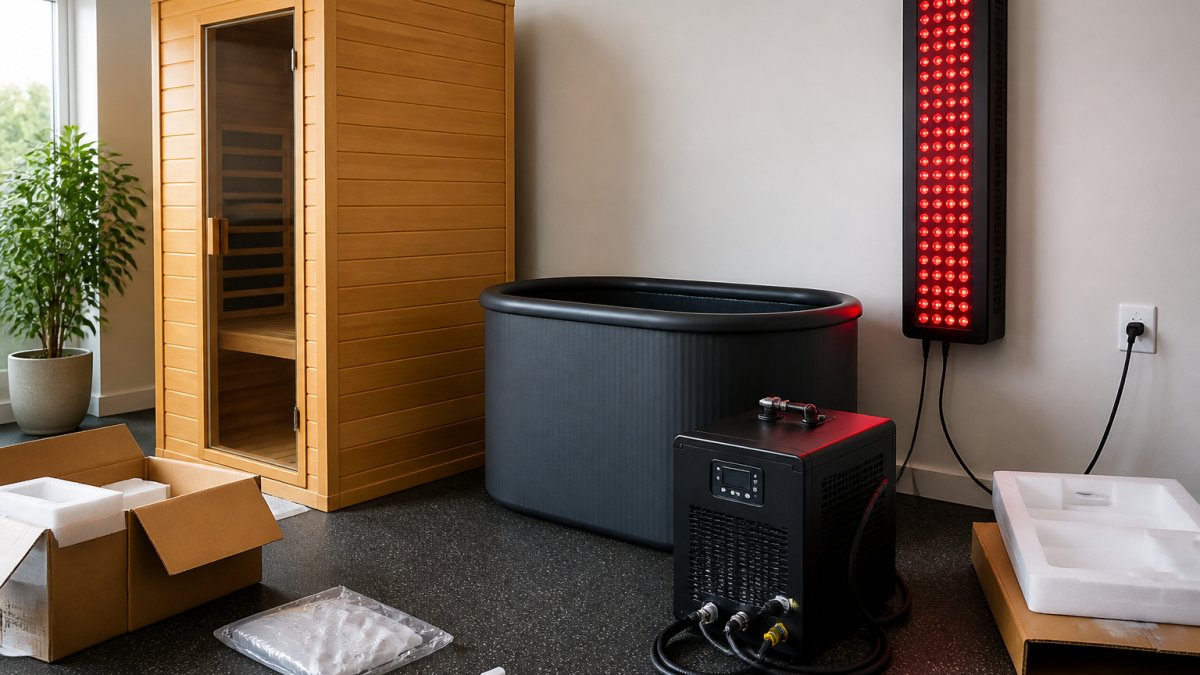
Power is the first constraint. The 6-person Great Bear needs 240 V at 20 A; the 1-person Sublime-901BR needs 120 V on a dedicated 15 amp circuit; the RevX LUX chiller recommends a dedicated 15 A circuit at 110 V. A full room can need three separate circuits.
Modtub 2.0 Cold Plunge System →
Floor load is the second. A filled Modtub 2.0 weighs about 850 lb; the Drift holds 80 gallons, roughly 670 lb; the Great Bear cabin weighs 484 lb empty. A second-floor room or raised deck needs checking before anything is filled.
Clearance is the third. The M9 massage chair needs about 3.9 inches behind it to recline fully and 69 inches of floor length when reclined. The Modtub needs about 75 inches of length with the chiller beside it. Measure the wall, not the room.
How to Inspect, Maintain, and Retire Recovery Equipment
Inspection separates a system that lasts from one that quietly degrades. Every item in a recovery room has consumables with replacement intervals.
On cold plunges, the filter cartridge is the wear item. The RevX X-FLOW uses a 10-inch 20-micron pleated cartridge. The Modtub 2.0 uses a 50-micron pleated filter with bypass and shutoff valves; the Drift ships with two spare filters.
On saunas, the routine is simpler. Wipe the benches and interior surfaces with a soft cloth after each session. Check the vents and the glass door weekly.
On light panels, the housing does the maintenance work. The Hooga panels use aluminum housings that pull heat away from the LEDs, and the ULTRA1500 adds integrated fans. Dust the face, keep the vents clear and check the hanging hardware.
| Equipment | Wear Item | Interval | What Fails If Ignored |
|---|---|---|---|
| Cold plunge | Filter cartridge | Every 2-4 weeks | Cloudy water, more chemical dosing |
| Cold plunge | UV-C lamp | Per manufacturer guidance | Sanitation drops, water quality falls |
| Sauna | Benches and vents | Wipe after each session | Cedar dries and cracks |
| Light panel | Vents and fans | Monthly dust check | LEDs run hot, output drifts |
| Massage chair | Roller track | Per manual | Rollers bind, tracking suffers |
Retirement criteria are simpler than most people expect. Retire any strap, rope or connection point showing abrasion, glazing or a compromised stitch line. For electrical equipment, a damaged cord or scorched plug ends the conversation.
Conclusion: Buying Recovery Equipment as One System
The hard part of building a recovery room is not picking a sauna or a plunge. It is making four pieces of equipment share one wall, one floor and one electrical panel without compromise.
We are independently owned and operated, and we publish the specifications that decide a purchase: heater count, wood species, chiller horsepower, wavelength, LED count, footprint and circuit requirements.
If you want a room that works as a system rather than a collection of mismatched purchases, start with our Modtub 2.0 Cold Plunge System at $3,199.00 and the SalusHEAT 1-Person Red Cedar Sauna at $2,289.00, then add the Hooga ULTRA1500 panel at $1,799.00 when the room is ready for it.
Frequently Asked Questions
What should you look for when choosing high quality recovery equipment for a home?
Start with published specifications rather than marketing copy. For a sauna, that means heater count and type, wood species, wattage, and voltage. For a cold plunge, chiller horsepower, temperature range, filtration micron rating, and filled weight. For a light panel, LED count, wavelengths in nanometres, irradiance at measured distances, and timer range. Equipment that lists these numbers lets you compare two products on the same terms. When a listing omits them, ask the maker before you buy.
How do you compare home recovery equipment specifications across categories?
Compare within a category, not across it. Two saunas are comparable on heater count, wood, and circuit requirements. A sauna and a cold plunge are not comparable on any shared number. Build a short list per category, then check how the pieces fit together: total electrical draw, combined floor footprint, and whether each unit needs its own circuit. A one-person cedar sauna draws 1,510 watts on 120 volts, while a six-person cabin runs on 240 volts at 20 amps, so the two are not interchangeable in the same room.
What equipment can you include in a home recovery room?
The common four are an infrared sauna, a cold plunge, a red light panel, and a massage chair. A one-person far infrared sauna measures 35.5 inches square, so it fits a bedroom corner or home gym. A compact cold plunge like the Modtub 2.0 needs about 75 inches of length with the chiller beside it. A full-height light panel hangs on a door with the included kit, and a zero gravity massage chair needs roughly 3.9 inches of wall clearance to recline. Pick the combination your room and circuits can carry.
How much space do you need for home recovery equipment?
Measure three things per unit: footprint, clearance, and access. A one-person sauna takes 35.5 by 35.5 inches. A RevX acrylic tub and chiller system occupies about 93 by 42 inches as a full system. A massage chair is 65 inches long upright and 69 inches reclined, with about 3.9 inches of wall clearance. Add walking room between pieces and check doorways before delivery. A 225-pound chair or a 484-pound sauna cabin has to physically reach the room you have in mind.
What electrical requirements should you check before buying a sauna or cold plunge?
Match the unit to a circuit you actually have. The one-person SalusHEAT Sublime-901BR draws 1,510 watts on a standard 120-volt, 15-amp outlet and should not share that outlet or run through an extension cord. The six-person HeatWave Great Bear needs 240 volts at 20 amps. The Modtub 2.0 chiller draws up to 4.7 amps, and the RevX LUX chiller runs on 110 volts at up to 11 amps, with a dedicated 15-amp circuit recommended. Confirm the outlet and breaker before delivery day.


