


Can You Put a Cold Plunge in a Garage? A Practical Guide
Table of Contents
- Can a Cold Plunge Go in a Garage?
- Planning Space and Floor Load for a Garage Cold Plunge
- What to Put Under an Indoor Cold Plunge
- Cold Plunge Electrical Requirements for a Garage
- Cold Plunge Chiller Performance in a Hot or Cold Garage
- Drainage, Humidity and Water Care in an Enclosed Garage
- Choosing the Right Stack For Wellness Plunge for Your Garage
- Frequently Asked Questions
Last Updated: November 4, 2026
Can a Cold Plunge Go in a Garage?
Yes, a cold plunge can go in a garage, and for many homeowners it is the most practical place to put one, since people often ask can you put a cold plunge in a garage before they commit to a spot. A garage usually has room, a hard floor and a nearby outlet, and it keeps the equipment out of the living space. Whether it works depends on the space you have, the weight of the tub, and how the room handles water and temperature.
Most garages are not climate-controlled, so the room temperature will shift with the seasons. That affects how hard the chiller works and how the water behaves. Plan for that before you buy.
Planning Space and Floor Load for a Garage Cold Plunge
Start with a tape measure, not a catalog. Measure the floor area, the ceiling height, and the clear width of the garage door opening. The Modtub 2.0 needs about 75 inches of length once the chiller sits beside the tub, so confirm that footprint fits with room to walk around the lid and reach the filter. The Drift Inflatable Cold Plunge is lighter when empty, but it still needs clear space to inflate and to step in and out safely.
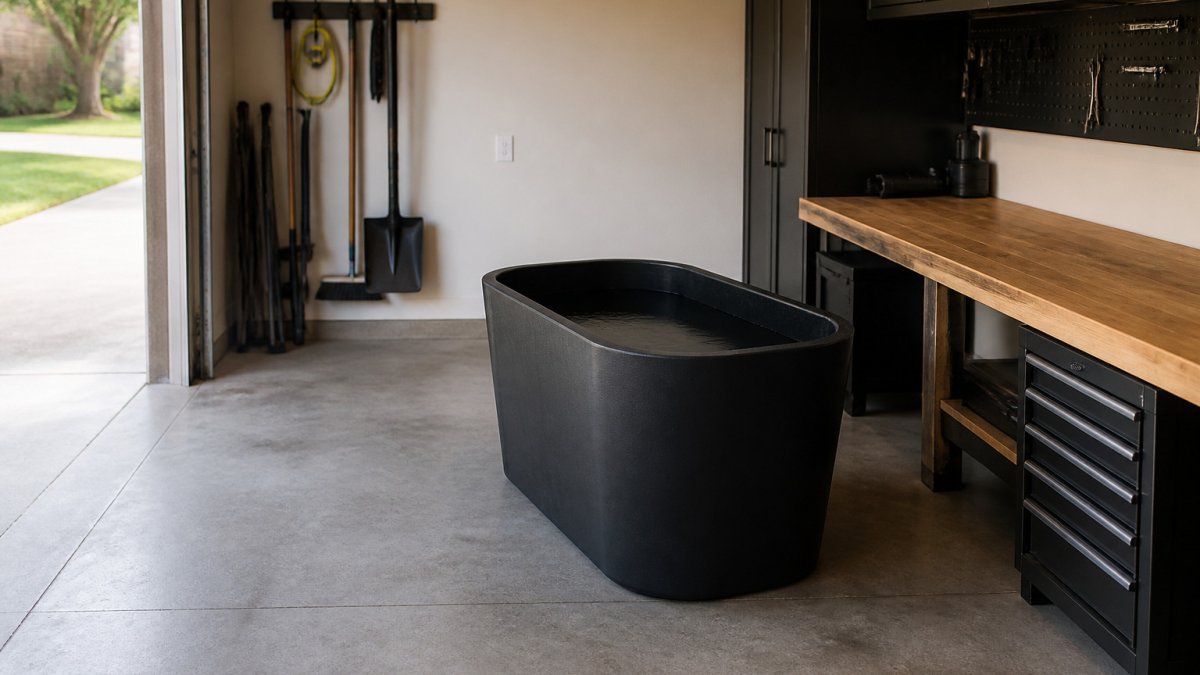
Weight is the part most buyers underestimate. A filled tub is mostly water, and water weighs about 8.34 lb per gallon. That gives you a simple way to estimate the load before you commit:
- Water weight: gallons × 8.34 lb. The Drift holds 80 gallons, so the water alone is about 670 lb. The 248-Gallon Inflatable tub holds 248 gallons when full, which is a substantial water load.
- Tub and equipment weight: add the empty tub, chiller, and any filtration cabinet. The Modtub 2.0 is listed at about 850 lb filled.
- User weight: add the heaviest person who will use it. A 200 lb user on a 670 lb filled Drift brings the point load to roughly 870 lb.
That total is a point load concentrated on the tub's footprint, not spread across the whole slab. A poured concrete garage slab on grade is the most common surface and is generally the most forgiving, but slab thickness, reinforcement, and the condition of the concrete vary from garage to garage. A thin floating floor, a raised wood platform, or a post-tension slab behaves very differently and may not be rated for a concentrated load of this size.
A practical way to sanity-check the load is to divide the filled weight by the tub's footprint in square feet. A 248-gallon tub holds a large water load on a relatively small footprint, which concentrates weight quickly before you add the tub and the user. Compare that number to what you know about your slab, and if you do not know the slab's thickness or reinforcement, that is the point to bring in a structural professional rather than guess.
Watch out: a garage slab that has handled cars for decades is not automatically rated for a sustained point load in one spot, especially near a control joint, a floor drain, or the edge of the slab. Have a licensed structural professional review the location if the filled weight is high, the slab is older, or you are placing the tub anywhere other than a poured slab on grade.
Level the floor before you set the tub down. A small tilt will make the water line uneven and can stress the tub walls over time. Check the manufacturer's specifications for any base or pad recommendation, and do not assume a foam mat substitutes for a level slab.
What to Put Under an Indoor Cold Plunge
A level, solid base is the first requirement. A poured concrete slab is the most stable surface in most garages. Avoid placing a filled tub directly on a thin floating floor or a raised wood platform unless the manufacturer's listing says the base is rated for it.
Keep the floor level before you set the tub down. A small tilt will make the water level uneven and can stress the tub walls over time. Check the manufacturer's specifications for any base or pad recommendation.
Cold Plunge Electrical Requirements for a Garage
Most of the products in this range run on standard household power. The Drift Inflatable runs on 100-120V, 60Hz, and needs no electrician. Set up the full contrast therapy station and its power needs. The RevX LUX system runs on a standard 110V outlet, and RevX recommends a dedicated 15A circuit for it.
Check the circuit before you plug anything in. A garage outlet shared with a freezer, a compressor or a power tool can overload. Use an outlet with GFCI protection, which is standard practice for any outlet near water. If you are unsure about your wiring, have a licensed electrician check the circuit before you install the chiller.
Most products in this range run on standard household power, though circuit requirements differ by model.
| Product | Power requirement | Note |
|---|---|---|
| Drift Inflatable Cold Plunge | 100-120V, 60Hz | No electrician needed |
| RevX LUX system | Standard 110V outlet | Dedicated 15A circuit recommended |
| Any garage outlet near water | GFCI protection | Standard practice for wet areas |
Cold Plunge Chiller Performance in a Hot or Cold Garage
The chiller works harder when the room is hot. A garage in summer can push the chiller to its limit, and a poorly insulated tub will lose cold faster. The Modtub 2.0 holds 37 to 39°F with a quarter-horsepower chiller, and its insulated lid seals the tub.
In winter, the risk is freezing. Garages without heat can drop below freezing, and cold plunge water can freeze in the lines or chiller. Drain or protect the system before temperatures fall, and follow the manufacturer's guidance for cold-weather operation.
Drainage, Humidity and Water Care in an Enclosed Garage
Plan how water leaves the garage before you fill the tub. There are four common routes, and the right one depends on whether your garage has a floor drain:
- Floor drain: the easiest setup. Route the tub's drain hose to the floor drain and let gravity do the work. Confirm the drain actually flows before you rely on it, garage floor drains are often clogged with years of debris.
- Drain hose to a utility sink or exterior door: works if the tub sits higher than the discharge point. A standard garden hose adapter on the tub drain is usually enough.
- Transfer pump: the practical answer when there is no drain and gravity will not cooperate. A small submersible pump moves water out through a hose to a sink, a slop sink, or outside.
- Manual draining: a bucket-and-hose fallback for small top-offs and spills, not for a full water change on a 248-gallon tub.
If the garage has no drain, decide the discharge route before the first fill. Draining 80 gallons across a garage floor is a cleanup problem; draining 248 gallons is a flood. Keep a wet/dry vacuum, a squeegee, and an absorbent mat near the tub for spills, and store them where you can reach them without walking through the wet zone.
Humidity is the slower problem. An enclosed garage traps moisture, and condensation shows up first on the coldest surfaces: the tub lid, the chiller housing, metal shelving, and the walls behind the tub. If you see water beading on the lid or rust starting on stored tools, the room is holding more moisture than it can shed. Run ventilation, an open garage door during and after a session, a wall vent, or a dehumidifier sized for the room, and keep stored items off the floor and away from the tub's splash zone. A dehumidifier with a continuous drain hose saves you from emptying a bucket every day.
Modtub 2.0 Cold Plunge System →
Water care ties into both. The RevX X-FLOW filtration cabinet uses a 200W pump, an 18W UV-C lamp, and a 20-micron pleated filter as part of its water treatment. Replace the filter according to the manufacturer's guidance. Between changes, skim debris after each session, keep the lid on when the tub is idle, and check the water line for buildup. In a garage, dust and pollen settle into an open tub quickly, so the lid is doing double duty as a debris cover and a humidity barrier.
Watch out: a garage that smells musty after a few weeks of tub use is telling you the ventilation is not keeping up. Address airflow before mold takes hold in drywall, cardboard storage, or the tub's own cabinet, because once it is established in an enclosed garage it is far harder to remove than to prevent.
Choosing the Right Stack For Wellness Plunge for Your Garage
Stack For Wellness is our top pick for a garage setup, and the choice comes down to your space and how you plan to use the plunge.
1. Modtub 2.0 Cold Plunge System ($3,199.00) The Modtub 2.0 is built in the USA from LLDPE and sits on a footprint of about 75 inches with the chiller beside it. It holds 37 to 39°F without ice, and setup takes about 10 minutes with no plumbing.
Best for: Garage owners with a solid concrete floor who want a permanent setup with consistent cold water. Skip if: your floor is not rated for a filled tub of this weight.
2. Drift Inflatable Cold Plunge with Cooling Unit ($2,309.00) The Drift is easy to move in and out of a garage. The tub weighs 34 lb empty and packs into a carry bag, and the 1 HP cooling unit runs on a standard household outlet.
Best for: Owners who want to store the tub when not in use, or who share the garage with a car. Skip if: you want the tub to stay permanently set up in a cold room.
3. 248-Gallon Inflatable Cold Plunge Tub with Hot & Cold ($1,409.00) This tub is 59 inches long, so you can lie down, and the chiller both cools to 37°F and heats to 113°F.
Best for: Owners who want a warm soak as well as a cold plunge in the same tub. Skip if: your garage floor cannot carry more than 2,000 lb.
4. RevX Acrylic X Tub Cold Plunge + LUX Chiller ($7,500.00) The RevX X Tub is more than 34 inches deep, so you can sit upright and stay submerged.
Best for: Owners who want a full system with separate filtration and a dedicated circuit. Skip if: budget is the main concern or you do not have a dedicated circuit available.
5. RevX X-FLOW Cold Plunge Filtration System ($800.00) The X-FLOW is a filtration and sanitation cabinet that adds to an existing cold plunge rather than replacing one. It uses a 200W pump, an 18W UV-C lamp and a 20-micron filter, and draws 3 amps maximum on 110V.
Best for: Owners who already have a cold plunge and want better water care. Skip if: you are buying a new plunge, since the X-FLOW is an accessory.
This product is intended for general wellness and relaxation. It is not a medical device and is not intended to diagnose, treat, cure, or prevent any disease.
Frequently Asked Questions
Is it okay to put a cold plunge in a garage?
Many people set a cold plunge up in a garage, and it is a practical spot because the floor is usually concrete, there is room for a tub and a chiller, and water is easy to manage. Before you commit, check that the floor can carry a filled tub, that the garage has a suitable outlet and that the room stays within a temperature range your chiller can handle. Keep the area ventilated so humidity does not build up.
Does a cold plunge use a lot of electricity?
Power use depends on the model. The RevX LUX system runs on a standard 110V outlet, with RevX recommending a dedicated 15A circuit. The Drift and 248-Gallon tubs run on standard 100-120V household power. Check the specific model's electrical draw before you plug it in and confirm the circuit can handle it.
What should you put under an indoor cold plunge?
Place the tub on a level, load-bearing surface such as a concrete slab. Filled, the Modtub 2.0 weighs about 850 lb, and the 248-Gallon inflatable tub holds 248 gallons of water, so confirm the floor can take that weight. A waterproof mat or drip tray can catch spills around the base. Avoid placing the tub on wood framing or a raised deck without a structural check.
Can a cold plunge chiller run in a hot garage?
A chiller has to reject heat into the room, so a hot garage makes it work harder. Ventilate the space and keep air moving around the chiller, and do not box it in. Keep the tub lid on between sessions to reduce how much cold the chiller has to hold.


