


Benefits of Integrated Wellness Systems
Table of Contents
- What Integrated Wellness Systems Actually Are
- How Infrared Sauna and Cold Plunge Work Together
- Building a Cohesive Home Wellness Room
- Home Sauna Space Requirements and Layout Planning
- Cold Plunge Maintenance and Year-Round Care
- Designing Your Routine Around Multiple Pieces of Equipment
- Why Consistency Matters More Than Individual Sessions
- Frequently Asked Questions
- Frequently Asked Questions
Last Updated: October 5, 2026
What Integrated Wellness Systems Actually Are
Integrated wellness systems combine multiple recovery and relaxation tools into a coordinated routine designed to work together. Rather than using a single piece of equipment in isolation, this approach stacks complementary devices, like infrared saunas, cold plunges, red light therapy panels, and massage chairs, to create a comprehensive home wellness environment.
At Stack For Wellness, we've spent years helping customers design these systems.
Most people buy wellness equipment reactively: a sauna first, then months later a cold plunge. The result is inconsistent specifications, incompatible space requirements, and a disjointed experience. An integrated approach flips this. You design the system first, then select equipment that fits your space, your routine, and your goals.

When devices are selected to work together, matching materials, specifications, and spatial requirements, your routine becomes effortless. You're not problem-solving logistics; you're focused on consistency.
How Infrared Sauna and Cold Plunge Work Together
The infrared sauna and cold plunge combination forms the backbone of most home wellness systems, alternating between heat and cold in a structured sequence.
Here's how the routine typically flows. You spend 20-30 minutes in the sauna. The far-infrared panels in units like the 1-Person Red Cedar Far Infrared Sauna with Bluetooth wrap heat around you from multiple angles, front, back, shoulders, legs, and feet, so there are no cold spots.
After your sauna session, you move directly to the cold plunge. The Modtub 2.0 Cold Plunge System holds water between 37 and 39°F without ice, thanks to its quarter-horsepower chiller. The ergonomic design gets you submerged to your shoulders, unlike stock tanks that leave your chest and knees exposed. You sit for 2-5 minutes, then return to the sauna for a second cycle.
A sauna with eight heating panels and a cold plunge with a precision chiller create a predictable, repeatable experience. You're not fighting inconsistent temperatures or awkward dimensions, and the routine becomes automatic.
:::pro-tip Start with shorter cold plunge durations (90-120 seconds) and work up gradually. The sauna-to-plunge transition is more manageable than jumping straight into extended cold exposure.
Building a Cohesive Home Wellness Room
Designing a wellness room requires thinking about flow, not just equipment placement. Most people arrange their space so the sauna and cold plunge sit adjacent to each other, minimizing the distance you travel between heat and cold.
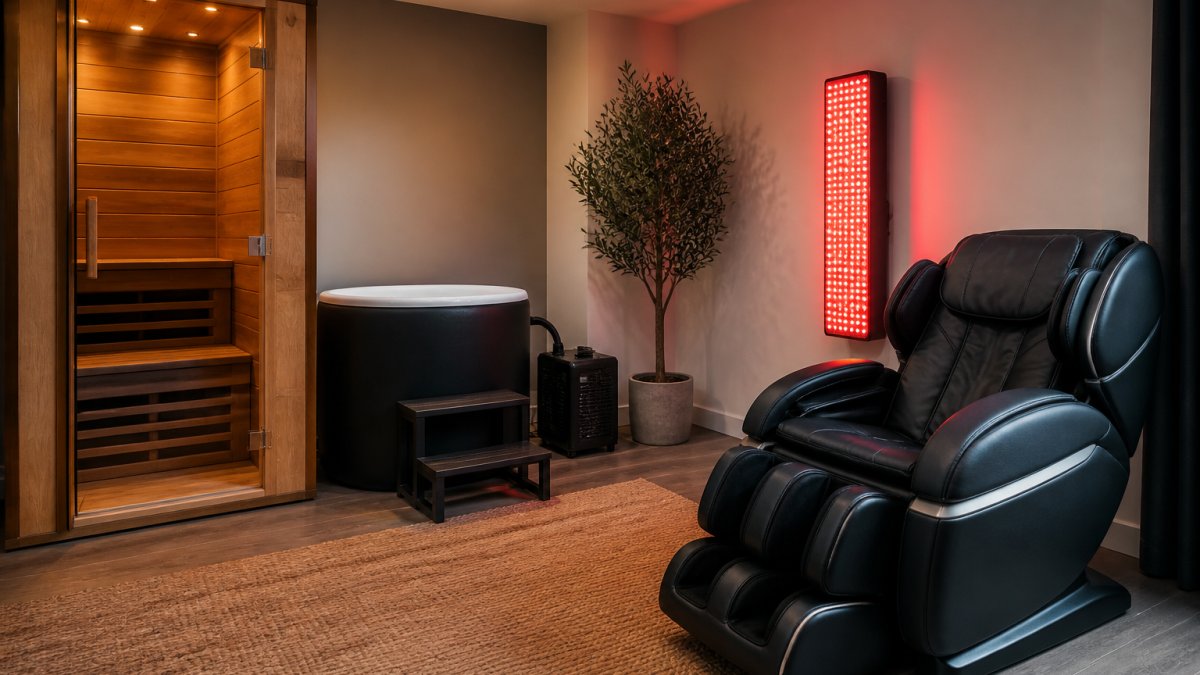
Start by measuring your space carefully. The sauna occupies roughly 35 inches square (for a one-person unit), and the cold plunge needs about 75 inches of length when you account for the chiller positioned beside it.
The M9 3D Full Body Massage Chair works well as the final piece in this sequence. After sauna and cold plunge, you spend 15-20 minutes in the chair.

Stack For Wellness customers often arrange their rooms in a circuit: sauna in one corner, cold plunge beside it, red light therapy panel on the wall opposite, and the massage chair positioned to face the room.
Polished concrete or tile is easier to clean than carpet, especially around the cold plunge.
Home Sauna Space Requirements and Layout Planning
A one-person infrared sauna like the SalusHEAT model occupies 35.5 inches square and stands 72.5 inches tall. It weighs about 225 pounds, so your floor needs to handle that load without deflection.
The sauna needs 3-4 inches of clearance from the wall behind it so the back panel can radiate heat properly. If you're placing it in a corner, leave at least 3 inches on both sides.
Electrical requirements are straightforward. The SalusHEAT Sublime-901BR plugs into a standard 120-volt outlet with a 10-foot cord. No special wiring, no plumbing, no installation service needed.
Temperature control is dual-panel: one control outside the door, one inside, so you can preheat the sauna before you enter and adjust mid-session without exiting. The two Bluetooth speakers and chromotherapy lights (which cycle through seven colors) are built in.
Ventilation is essential. If you're building a dedicated sauna room, install a small exhaust fan or leave a window cracked during use. Cedar naturally resists moisture, but stagnant air creates an unpleasant environment.
Cold Plunge Maintenance and Year-Round Care
The Modtub 2.0 requires minimal maintenance compared to stock tank setups. The 50-micron pleated filter with bypass valves keeps the water clean between changes, and the insulated lid seals the tub so debris doesn't accumulate.
Water changes depend on usage frequency. If you're using the plunge 5-6 times per week, plan to change the water every 2-3 weeks. If you use it less frequently, monthly changes are sufficient.
Year-round operation is possible, even in cold climates. The chiller maintains 37-39°F regardless of ambient temperature, and the insulated lid prevents it from fighting outdoor cold. In summer, keep the tub in a shaded location if possible.
The filter is the only consumable part. Replace it every 3-4 months depending on water clarity and usage.
One often-overlooked detail: the floor under the plunge needs to handle weight. Filled, the tub weighs about 850 pounds. Concrete and engineered joists handle this easily.
M9 3D Full Body Massage Chair →
Designing Your Routine Around Multiple Pieces of Equipment
The value of an integrated wellness system is routine consistency. Most people who buy single pieces of equipment use them sporadically: a sauna session when they remember, the cold plunge when they feel like it, and the massage chair becomes a piece of furniture.
A structured routine changes this. Here's a practical framework that Stack For Wellness customers follow:
-
Sauna session: 20-30 minutes. Start at 130-140°F and let your body acclimate. The first 5 minutes feel warm; by minute 10, you're settled. Spend the remaining time relaxing. Bring water and sip slowly.
-
Cold plunge: 2-5 minutes. Exit the sauna and move directly to the plunge. Start with 2 minutes if you're new to cold exposure, and work up to 5 minutes over weeks. Stay in until you feel your breathing stabilize.
-
Recovery period: 5-10 minutes. Towel off, drink water, and let your body temperature normalize. This is when many people sit in the massage chair.
-
Massage session: 15-20 minutes. The M9 chair's 3D rollers and zero-gravity recline complement the contrast therapy cycle. The massage chair provides a separate seated session; arrange the equipment so you can move between stations without obstructing walkways.
-
Red light therapy: 10-15 minutes. The Hooga PRO1500 panel covers your whole back or front in one session. Hang it on a door mount or ceiling hook, stand 6-12 inches away, and let the 300 dual-chip LEDs deliver both 660nm red and 850nm near-infrared wavelengths.

Hooga PRO1500 Red & Near Infrared Light Therapy Panel
This full routine takes about 60-90 minutes. Most people do it 2-3 times per week, though some use the sauna alone on off days.
Why Consistency Matters More Than Individual Sessions
One session in an infrared sauna or cold plunge produces a temporary sensation. Consistency over weeks and months is what builds a sustainable routine.
This is where integrated systems win.
The research on habit formation suggests that consistency is key: a moderate routine you do reliably is often more sustainable than an aggressive protocol you abandon after two weeks.
Most people also find that their preferences evolve. You might start with sauna and cold plunge, then add red light therapy, or use the massage chair more in winter and less in summer.
A dedicated wellness room, even a corner of a garage, signals priority. You're not squeezing wellness into leftover space; you're investing in a coherent environment.
Stack For Wellness exists because we focus on cohesive system design. One customer buys a sauna in isolation and uses it inconsistently.
This product is intended for general wellness and relaxation. It is not a medical device and is not intended to diagnose, treat, cure, or prevent any disease.
Frequently Asked Questions
What's the difference between far infrared and near infrared wavelengths?
Infrared saunas use radiant heat; compare each manufacturer's heater specifications rather than inferring tissue effects from the infrared label. Near infrared (700-1,400 nanometers) is closer to visible light and is used in red light therapy panels. The Hooga PRO1500 delivers both 660nm red and 850nm near-infrared wavelengths in every diode, so you get both types in a single session. Sauna heaters and red light panels are different equipment categories; compare their stated wavelengths, electrical requirements and installation instructions separately.
Can I use the sauna and cold plunge every day?
Most people use the sauna 2-5 times per week. Daily use is possible, but it's not necessary for consistency benefits and can become monotonous. Cold plunge frequency should match sauna use, if you're doing sauna twice weekly, do cold plunge twice weekly. Listen to your body and adjust frequency based on how you feel. Some users prefer 3 sessions per week as a sustainable middle ground.
How much space do I actually need for a full integrated wellness system?
A one-person sauna (35 inches square), cold plunge (75 inches long), and massage chair (69 inches reclined) need roughly 200-250 square feet if arranged in a circuit. You can fit a basic system in a 12-by-15-foot garage or spare room. A red light therapy panel mounts on the wall, so it doesn't consume floor space. If your space is tighter, prioritize the sauna and cold plunge first, they form the core routine, and add the massage chair later.
What's the real ROI of a home wellness system versus going to a spa or gym?
The ROI is primarily time and consistency. A sauna session at a spa costs $30-60 and requires travel. At home, it's free after the initial investment and takes zero travel time. Most people who build a home system use it 2-3 times weekly, a frequency they'd never maintain at a commercial facility. Over a year, you'll do 100+ sessions at home versus maybe 20-30 at a spa. The equipment pays for itself in convenience and consistency alone, before any wellness benefits enter the equation.
Frequently Asked Questions
What does an integrated wellness system mean at home?
An integrated wellness system combines multiple recovery pieces, saunas, cold plunges, red light panels, and massage chairs, selected to work together in one space. Rather than buying equipment randomly, each piece complements the others. For example, a sauna session followed by a cold plunge creates a contrast protocol, while a red light panel can occupy a separate station in the room. The key is that all equipment shares the same design language and technical standards, so they fit the space seamlessly and work toward the same wellness goal.
How do you maintain a cold plunge system year-round?
Cold plunge maintenance involves three core tasks: filter changes, water testing, and chiller care. The Modtub 2.0 uses a 50-micron pleated filter that should be inspected monthly and replaced when water flow slows. Test water chemistry every 2-3 weeks using test strips to monitor pH and sanitizer levels. Keep the chiller's condenser coils clean by vacuuming dust quarterly. In winter, if your plunge is outdoors, insulate the chiller unit and ensure the lid stays sealed to reduce heating load. Most owners find a simple 10-minute monthly routine prevents major issues.
How much space do you actually need for home sauna setup?
A single-person sauna like the SalusHEAT Sublime-901BR requires just 35.5 inches square (about the footprint of a small closet) and fits in a bedroom corner, spare room, or home gym. Plan at least 72.5 inches of ceiling height. If you're adding a cold plunge beside it, allow 75 inches of length for the Modtub 2.0 plus the chiller unit. A massage chair needs about 3.9 inches of wall clearance to recline fully. Most homes can carve out a dedicated wellness corner in 150-200 square feet without major renovation.
What's the actual benefit of combining a sauna and cold plunge instead of using them separately?
When used as a contrast protocol, alternating between heat and cold, the two pieces create a more complete session than either alone. The sauna prepares your body and opens your routine, while the cold plunge follows, creating a deliberate shift. Used together consistently, they form a ritual that can be easier to maintain than bouncing between a gym sauna and a spa cold plunge. You also save time: a 15-minute sauna followed by a 3-minute plunge takes 20 minutes at home versus 90 minutes traveling to and from a facility. Consistency is what builds value, and home integration makes consistency possible.


