Is Red Light Therapy Worth It? An Honest 2026 Guide
Table of Contents
- How Red Light Therapy Works
- Red Light Therapy Benefits and Side Effects
- How Long Should You Use Red Light Therapy?
- FDA Clearance for Red Light Therapy Devices
- At-Home Devices vs. Professional Treatments
- Device Quality and Technical Specifications
- Contraindications with Skincare Actives
- Conclusion: Is Red Light Therapy Worth It?
- Frequently Asked Questions
Last Updated: September 19, 2026
How Red Light Therapy Works
Red light therapy is a non-invasive treatment that uses specific wavelengths of light to stimulate cellular activity in the skin and underlying tissue. This guide from Stack For Wellness breaks down the science, the realistic benefits, and the practical questions to answer before buying a device.
Photobiomodulation and Mitochondrial Function
When photons hit the cytochrome c oxidase enzyme in your mitochondria, the process can increase ATP production and reduce oxidative stress.
Wavelengths and Skin Penetration
Wavelength determines how deep light travels. Red light at 660 nanometers absorbs mostly in the epidermis and upper dermis, useful for surface-level concerns. Near-infrared at 850 nanometers reaches deeper into muscle and joint tissue.
Red Light Therapy Benefits and Side Effects
The benefits most consistently reported in clinical literature center on skin rejuvenation, reduced inflammation, and modest improvements in wound healing. Side effects are rare when used as directed. What separates a credible claim from a marketing one is whether the outcome has been measured in a controlled trial at a stated wavelength and dose.
| Claimed Benefit | Evidence Strength | Typical Study Design | What It Realistically Delivers |
|---|---|---|---|
| Collagen synthesis / fine lines | Moderate to strong | Split-face randomized trials, 660nm | Softer lines, firmer feel after 8-12 weeks |
| Inflammation / erythema reduction | Moderate | Small trials, 630-850nm | Calmer redness, less post-procedure swelling |
| Acne vulgaris lesions | Moderate | Randomized trials, blue + red combos | Fewer inflammatory lesions as adjunct therapy |
| Wound healing | Moderate | Post-surgical and diabetic ulcer studies | Faster closure in supervised settings |
| Hair regrowth | Emerging | Small trials, 650-900nm | Modest density change, not restoration |
| Joint and muscle pain | Mixed | Heterogeneous trials, 810-850nm | Short-term relief, inconsistent across studies |
| Weight loss / fat reduction | Not supported | None credible | Nothing |
Collagen Synthesis, Fine Lines, and Skin Rejuvenation
Collagen synthesis has the strongest evidence base. Split-face randomized trials, where one side of the face receives treatment and the other serves as a control, consistently show increased fibroblast activity and measurable improvements in skin elasticity after several weeks of consistent use. The split-face design controls for the placebo effect that inflates self-reported results in open-label studies.
Acne, Rosacea, and Inflammation Reduction
Inflammation reduction is where near-infrared wavelengths do the heavy lifting, calming erythema associated with rosacea and reducing redness around active acne vulgaris lesions. For acne, the strongest protocols pair blue light (around 415nm) for Cutibacterium acnes with red light for inflammation. A red-only panel addresses half the problem.
Safety Profile and Who Should Avoid It
The safety profile is favorable for most healthy adults. Erythema, or mild redness, is the most common complaint and typically fades within hours. Published literature reports no serious adverse events at consumer wavelengths and doses when the eyes are protected.
What the Evidence Does Not Support
Discount these claims: systemic detoxification, weight loss, thyroid regulation, and "cellular reset." None have credible trial support at consumer wavelengths and doses. If a product page leads with them, treat the rest of the page with the same skepticism.
How Long Should You Use Red Light Therapy?
The standard session length is 10 to 20 minutes per treatment area, three to five times per week. More time does not produce better results and can trigger the opposite effect.
FDA Clearance for Red Light Therapy Devices
FDA clearance for red light therapy devices falls into two categories. Some devices are cleared as medical devices for specific indications; most consumer panels are sold as general wellness products and carry no medical claims.
At-Home Devices vs. Professional Treatments
At-home devices have closed most of the performance gap with clinical treatments, but trade-offs remain. A professional session delivers higher irradiance in a shorter window under supervision. A home panel delivers lower output but lets you treat consistently, where most of the benefit accumulates.
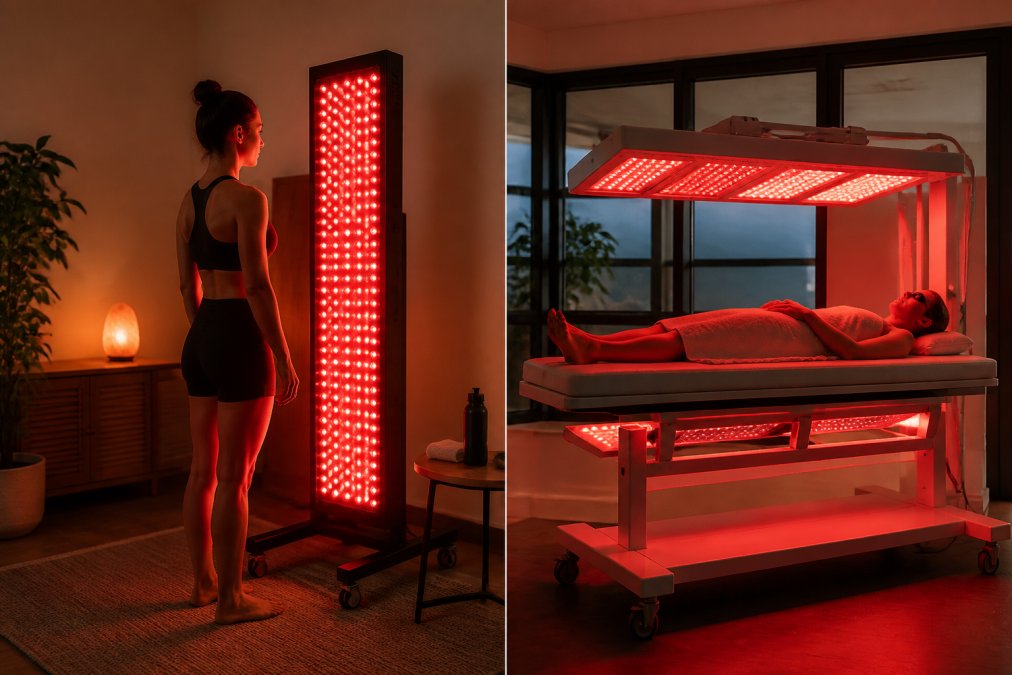
The Real Trade-Off, Side by Side
| Factor | Professional Session | At-Home Panel |
|---|---|---|
| Irradiance at skin | High (often 100-200 mW/cm²) | Lower (typically 20-80 mW/cm² at 6 in) |
| Session length | 5-15 minutes | 10-20 minutes per area |
| Cost model | Per-visit fee, recurring | One-time device cost |
| Supervision | Clinician adjusts dose | You manage dose |
| Consistency | Limited by schedule and cost | Daily possible |
| Best for | Acute concerns, post-procedure | Long-term maintenance |
Neither column wins outright. Professional wins on dose per session; home wins on total dose per year, the number that correlates with cumulative collagen change.
A Maintenance Protocol Most Guides Skip
Most articles stop at "use it consistently." That is not a protocol. Here is a schedule that matches how the trials are structured.
When Professional Treatment Is the Better Call
Choose a clinic over a home panel if you have a recent surgical incision, an active skin cancer diagnosis, a chronic condition requiring prescription photosensitizing medication, or a concern like deep scarring that needs a dermatologist's assessment before any light exposure. A clinician can also deliver wavelengths and doses a consumer panel cannot reach, which matters for deeper tissue targets.
When Home Wins
Choose a home panel for long-term skin maintenance, general recovery support, or daily-use convenience. The economics favor home use after roughly a handful of clinical visits, and the frequency advantage compounds over years. Stack For Wellness builds its catalog around that idea: cohesive recovery systems where the panel, sauna, and cold plunge complement each other rather than sit as mismatched one-offs.
Device Quality and Technical Specifications
| Specification | What to Check | Why It Matters |
|---|---|---|
| LED count | Total diodes and chips per diode | Determines coverage and session time |
| Wavelengths | 660nm red, 850nm near-infrared | Match wavelength to the outcome |
| Irradiance | mW/cm² at a stated distance | Real dose, not marketing wattage |
| EMF rating | Milligauss at use distance | Lower is better for daily use |
| Build | Aluminum housing, cooling | Keeps output steady over years |
Stack For Wellness publishes heater counts, wood species, and EMF ratings on every listing for exactly this reason. Informed purchasing starts with specifications you can compare.
Contraindications with Skincare Actives
Skincare actives and light therapy can work against each other, a contraindication most guides skip. Retinoids, alpha hydroxy acids, and high-concentration vitamin C increase photosensitivity in the epidermis.
Ingredients to watch:
- Tretinoin and prescription retinoids: wait 4 to 6 hours
- Glycolic and lactic acid peels: skip the panel that day
- High-percentage vitamin C serums: apply post-session
- Photosensitizing antibiotics: consult your prescriber first
Conclusion: Is Red Light Therapy Worth It?
For most people asking whether red light therapy is worth it, the honest answer depends on whether you will use it consistently. Clinical efficacy for collagen synthesis, inflammation reduction, and tissue repair is well documented at the right wavelengths and dose. The variable is you.
Frequently Asked Questions
What is the downside of red light therapy?
The main downsides are the time commitment and the need for consistency. Sessions are non-invasive and generally well tolerated, but results for skin rejuvenation or tissue repair take weeks of regular use. Some users experience mild erythema or temporary redness after sessions. It is not a quick fix, and it does not replace medical treatment for conditions like severe acne vulgaris or chronic wounds. Also, quality varies widely between devices, so a cheap panel with low irradiance may not deliver the same results as a higher-output unit.
How long does it take to see results from red light therapy?
Most users notice early changes in skin tone or muscle soreness within 2 to 4 weeks of consistent use. Collagen synthesis and fine line reduction typically take 8 to 12 weeks because the dermal layers remodel slowly. For inflammation or wound healing, some people report improvement in days, but clinical efficacy studies often measure outcomes at 6 to 12 weeks. The key is sticking to a schedule, usually 3 to 5 sessions per week, rather than expecting overnight changes.
Is home red light therapy as effective as professional treatments?
It can be, if the device has sufficient irradiance and the right wavelengths. Professional clinics use high-output panels with precise dosimetry, but many at-home devices now deliver comparable power at 660nm and 850nm. The difference often comes down to total joules delivered per session and treatment area. A full-body panel like the Hooga PRO1500 or ULTRA1500 can cover more surface area in one session than a small handheld unit, which makes consistent home use more practical for long-term maintenance.
Do red light therapy devices need FDA clearance?
The FDA regulates red light therapy devices as either general wellness products or medical devices, depending on the claims made. General wellness devices are not cleared for treating specific conditions, while those with medical claims require 510(k) clearance. When a product is marketed for general wellness and relaxation, it does not need FDA clearance, but it also cannot claim to diagnose, treat, cure, or prevent disease. Always check the labeling to understand what a device is cleared for before buying.
The challenge with red light therapy is not the science. It is picking a device with honest specifications and building a routine around it. Stack For Wellness publishes LED counts, wavelengths, EMF ratings, and build materials on every panel so you can compare real numbers instead of marketing language. Browse the PRO1500, the ULTRA1500, or the full-body Red Light Therapy Blanket and get started with a recovery system designed to work together.