


7 Steps to Choose the Right Red Light Wavelength
Last Updated: November 2, 2026
Quick Summary
The right red light wavelength depends on your routine and the body area you want to cover. Red light at roughly 630 to 660 nm works mainly at the skin's surface, while near-infrared at roughly 810 to 850 nm reaches deeper. Many shoppers choose a panel that carries both bands.
- Red light panels typically emit around 630 to 660 nm, while near-infrared sits around 810 to 850 nm.
- Shorter wavelengths stay closer to the surface, and longer wavelengths reach further in.
- Match the band to your routine and body area before comparing panel size or price.
- A combination panel runs both bands in one session, so you do not need a second device.
- Confirm the listing names a peak wavelength in nanometers before you buy.
Table of Contents
- How Red Light Wavelengths Differ and Why They Matter
- Red Light vs Near-Infrared Light: Which Band Fits Your Goals
- Red Light Therapy Wavelength Chart: Common Bands at a Glance
- Matching Wavelengths to Your Goal: A Decision Guide
- Session Length, Distance and Dose: How Wavelength Interacts With Them
- How to Choose a Red Light Therapy Panel for Your Space
- Booking Your Next Step: Pick a Panel That Matches Your Wavelength Plan
- Frequently Asked Questions
Choosing the right red light wavelength is the single most important decision you will make when buying a panel. Stack For Wellness has put together this guide to help you match a wavelength to what you actually want from your recovery routine. Most shoppers focus on panel size or price first, but the wavelength decides what the light does at the surface and how deep it travels.
How Red Light Wavelengths Differ and Why They Matter
Light is measured in nanometers (nm), and each wavelength sits at a different point on the spectrum. Red light panels typically emit light around 630 to 660 nm, while near-infrared bands sit higher, around 810 to 850 nm.
Shorter wavelengths tend to stay closer to the surface. Longer wavelengths reach further in. That difference is the reason manufacturers list wavelengths so prominently, and it is the first thing to check on any listing.
Red Light vs Near-Infrared Light: Which Band Fits Your Goals
Red light and near-infrared light are related but not interchangeable. Red light, roughly 630 to 660 nm, is visible to the eye and works mainly at the skin's surface. Near-infrared, roughly 810 to 850 nm, is invisible and reaches deeper into tissue.
- Red light (630 to 660 nm): Visible, surface-focused, common in panels for skin-care routines.
- Near-infrared (810 to 850 nm): Invisible, deeper reach, often paired with red in full-spectrum panels.
- Combination panels: Run both bands in one session, so you do not have to choose.
Many shoppers do not need to pick one band over the other. A panel that carries both covers the full range without a second device.
Red Light Therapy Wavelength Chart: Common Bands at a Glance
Use this chart to compare the wavelengths found across the Stack For Wellness panels.
| Panel | Wavelengths | Best For |
|---|---|---|
| PRO1500 | 660 nm red, 850 nm near-infrared | Full-body coverage with both bands |
| ULTRA1500 | 630, 660, 810, 850 nm | Head-to-toe sessions with four wavelengths |
| ULTRA360 | 630, 660, 810, 850 nm | Desk or nightstand use with four wavelengths |
| Illuminate Red V2 | 660 nm red | Surface-focused red-only sessions |
Check the wavelength on any panel before you buy. A listing that does not name the nanometer figure is hard to compare.
Matching Wavelengths to Your Goal: A Decision Guide
Most wavelength guides stop at "red for skin, near-infrared for depth." That is a starting point, not a decision. The guide below maps common routine goals to wavelength ranges, body areas, and the trade-offs you should weigh before buying. It also flags where the published research is stronger and where it is still preliminary, so you can separate a wavelength that fits your routine from a wavelength that is simply well marketed.
Step 1: Name the routine, not the outcome
Write down what you actually want the panel for. Common patterns include a surface skin-care routine, a post-workout routine for large muscle groups, a general wellness session for the torso and back, and a relaxation routine in a recovery room. The routine tells you which body areas the light needs to reach, and that in turn tells you which wavelength band matters most.
Step 2: Match the body area to the band
| Routine focus | Body areas typically covered | Wavelength range to prioritize | Why |
|---|---|---|---|
| Surface skin-care routine | Face, neck, hands, forearms | 630-660 nm red | Shorter visible red wavelengths are the conventional choice for surface-focused sessions |
| Post-workout routine | Thighs, glutes, back, shoulders | 810-850 nm near-infrared | Longer wavelengths are the conventional choice when the session targets larger, deeper body areas |
| General wellness session | Torso, back, full body | 630-660 nm plus 810-850 nm | A combination panel lets you run both bands in one session |
| Relaxation routine | Any comfortable seated or standing position | Either band, based on personal preference | Comfort and consistency matter more than the band here |
Step 3: Weigh evidence quality by wavelength
The published literature is not evenly distributed across wavelengths. A few patterns are worth knowing before you read a product page:
- 630-660 nm red: The most studied band in small trials, often with skin-related endpoints. Many of these trials are small, short, and use different devices, so a wavelength alone does not guarantee a given result.
- 810-850 nm near-infrared: Also well represented in small trials, often with different endpoints and device setups. Results vary widely by dose and device, which is why the wavelength figure on its own is not a reliable predictor.
- Other bands (for example 940 nm or 1064 nm): Less common in consumer panels and less represented in the trial literature. Treat claims about these bands with more caution.
A small randomized trial reported differences between wavelength groups, but the sample sizes were limited and the devices were not identical to consumer panels. That is the pattern across most of this literature: promising, preliminary, and not a substitute for your own consistent routine.
Step 4: Decide between red-only, near-infrared-only, and combination
- Red-only panels: Best if your routine is surface-focused and you want a simpler device. The Illuminate Red V2 is a red-only option at 660 nm.
- Near-infrared-only panels: Less common in consumer catalogues; usually chosen when the routine is entirely body-focused.
- Combination panels: The most flexible choice for most shoppers. The PRO1500 runs 660 nm red and 850 nm near-infrared; the ULTRA1500 and ULTRA360 run four wavelengths (630, 660, 810, 850 nm) so you can switch bands without buying a second device.
Step 5: Sanity-check the listing before you commit
A wavelength figure on a product page is a claim, not a measurement. Before you buy, confirm the listing names the peak wavelength in nanometers, states whether the figure is peak or a range, and lists the LED count per wavelength.
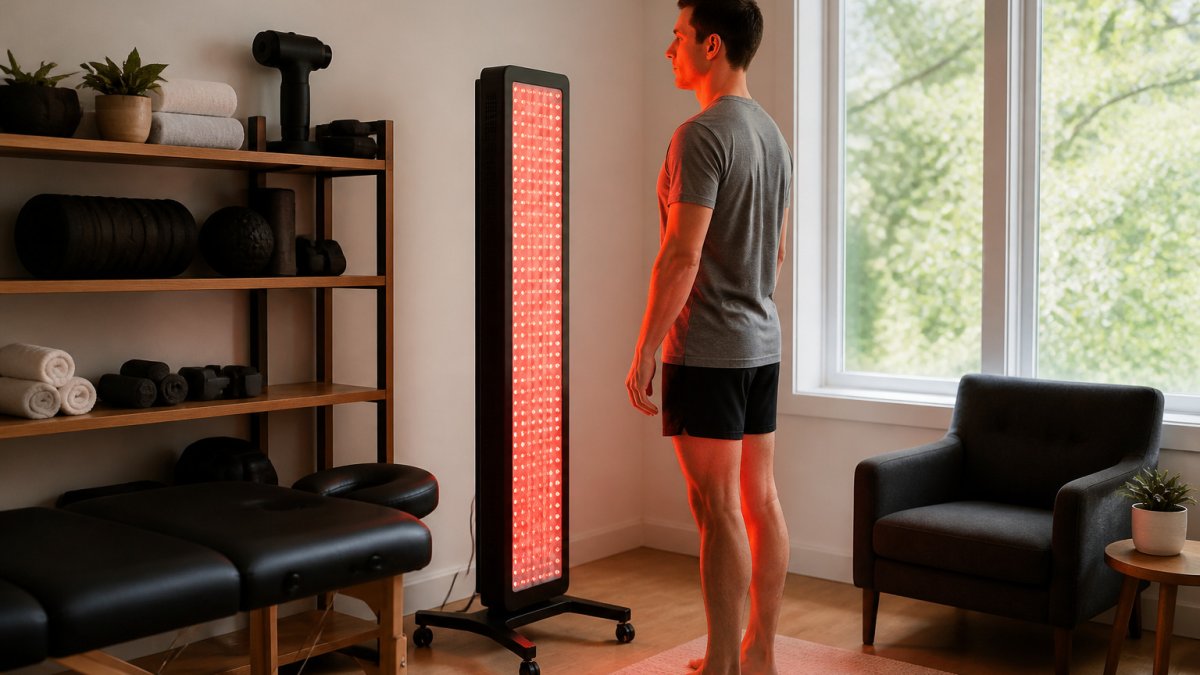
Hooga PRO1500 Red & Near Infrared Light Therapy Panel →
Session Length, Distance and Dose: How Wavelength Interacts With Them
Wavelength is only one variable in a session. The same panel at the same wavelength can deliver very different amounts of light depending on three things: how far you stand from it, how long the session runs, and how bright the panel is set. Competitors often mention dose without explaining it; this section breaks down the variables so you can build a routine you can actually repeat.
The three variables that set your dose
- Irradiance (power density): How much light lands on a given area per second, usually expressed in milliwatts per square centimeter (mW/cm²). A panel's irradiance drops sharply as you step away from it.
- Distance: Light spreads out as it travels. Doubling your distance from a panel does not halve the light; it reduces it much more steeply. This is why the manufacturer's recommended distance matters more than the panel's headline wattage.
- Session time: Dose is irradiance multiplied by time. A shorter session close to the panel and a longer session farther away can land in a similar range, but the trade-offs differ (coverage, comfort, and how much of the body is in the beam).
A practical way to think about distance
Most consumer panels publish a recommended distance, often in the range of a few inches to a couple of feet. Treat that figure as the starting point, not a suggestion.
If a listing does not state a recommended distance, that is a gap worth asking about before you buy. You cannot reliably compare two panels on dose if one gives a distance and the other does not.
Session time and the timer
Stack For Wellness panels include built-in timers and brightness controls, which makes it easier to hold distance and session length constant from one session to the next. The ULTRA1500 and ULTRA360 both offer touchscreen or remote control for adjusting brightness and session length. Use the timer to standardize your sessions rather than watching the clock; consistency is what makes a routine comparable week to week.
What wavelength does and does not tell you about dose
A wavelength figure tells you where the light sits on the spectrum. It does not tell you how much light the panel emits, how that light spreads, or how much reaches your body at a given distance. Two panels with identical wavelength specs can differ substantially in irradiance and beam coverage. That is why a wavelength-only comparison is incomplete: you need the wavelength, the irradiance figure (or at least the manufacturer's recommended distance and session time), and the LED count to compare panels fairly.
A repeatable session checklist
- Set the panel at the manufacturer's recommended distance and mark the spot on the floor so you return to the same place.
- Choose a session length you can repeat several times a week, and set the timer.
- Keep brightness at one setting for a full week before changing anything.
- Note the wavelength band you used (red, near-infrared, or both) so you can compare routines over time.
This product is intended for general wellness and relaxation. It is not a medical device and is not intended to diagnose, treat, cure, or prevent any disease.
How to Choose a Red Light Therapy Panel for Your Space
Space matters as much as wavelength. A full-height panel needs floor room and a spot to hang or stand, while a compact model fits on a desk or shelf.
- Limited space: The ULTRA360 is about 12.7 inches tall and sits on its own stand.
- Full-body coverage: The PRO1500 and ULTRA1500 are tall panels that hang on a door or hook, with no wall drilling needed.
- Carry and move: A handle on the ULTRA360 makes it easy to move room to room.
Measure the spot before you buy, and confirm the power cord and mounting option suit your layout.
Booking Your Next Step: Pick a Panel That Matches Your Wavelength Plan
Once you know the band you want, look at the Stack For Wellness range and find the panel that fits your space and routine. The Hooga PRO1500 Red & Near Infrared Light Panel suits anyone who wants full-body coverage with red and near-infrared in every diode. If you need four wavelengths in a compact footprint, the Hooga ULTRA360 Red & Near Infrared Light Therapy Panel is a practical choice.


Frequently Asked Questions
What wavelength should I look for in a red light panel?
Look for panels that state their wavelengths in nanometers on the spec sheet. Red light is commonly listed around 630nm to 660nm, and near-infrared is commonly listed around 810nm to 850nm. Panels that list the exact wavelengths, LED count and output in one place make comparison easier. If a manufacturer does not state wavelengths clearly, check the product listing or contact the maker before buying. Match the bands to your own goal rather than assuming more wavelengths is better.
What is the difference between red light and near-infrared light?
Red light sits in the visible range, typically around 630nm to 660nm, while near-infrared sits just beyond what the eye can see, typically around 810nm to 850nm. Because near-infrared wavelengths are longer, they are often described as reaching deeper into the body, though that depth is a general description of light physics, not a guaranteed outcome. Many panels combine both bands so you can choose between a red-only or combination setup based on your preference.
Does a panel with more wavelengths mean it is a better choice?
Not necessarily. More wavelengths give you more options, but they do not automatically make a panel better for your use. A red-only panel can suit a simpler routine, while a combination panel offers both red and near-infrared bands in one session. Compare the specifications that matter for your setup, including wavelength list, LED count, panel size, controls and warranty terms. Choose the configuration that fits your space and routine, and treat wavelength count as one factor among several.
How long should a red light panel session last?
Session length depends on the panel's output, the distance you stand from it and the routine you want to follow. Many manufacturers include a built-in timer, and the product manual usually lists recommended session durations for that model. Follow the manufacturer's guidance for your specific panel rather than a generic number. Short, consistent sessions are often easier to maintain than long, irregular ones, so pick a duration you can realistically repeat.


